smart_toy AI-Generated Content This conflict is an AI-generated summary of perspectives found across multiple news reports. It does not determine factual truth or a winning side.

China vs Philippines

China

Chinese tech firms
Chinese tech firms
Chinese government
Chinese government
China
China
Chinese Foreign Ministry
VS

Philippines

Philippines

The territorial dispute between China and the Philippines in the South China Sea involves conflicting claims over islands, reefs, and maritime rights.

China asserts historical sovereignty over the area, while the Philippines has enacted laws defining baselines around features like Huangyan Dao, which China rejects.

The dispute has led to periodic confrontations, including vessel collisions and clashes between naval personnel, and has been a source of regional tension.

Economic ties between the two countries remain strong, but public trust in the Philippines toward China is generally negative.

*AI-generated summary of publicly available data. This is not an official statement of any party.

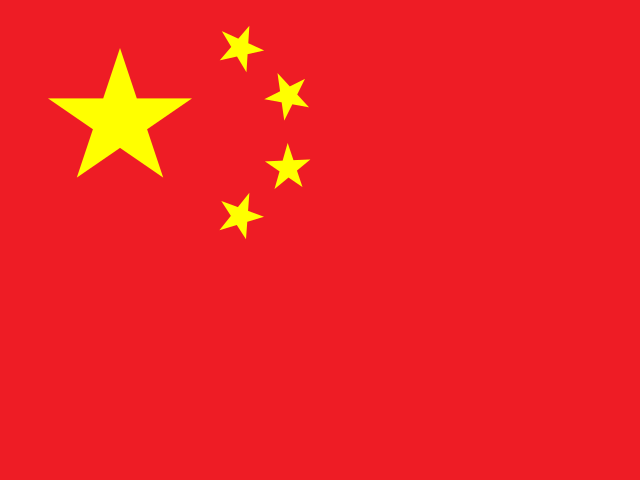
AI-Generated China Narrative

*AI-generated summary of publicly available statements and reporting. This is not an official statement of this party.

Supporters of China argue that its claims rest on centuries of continuous cultural and historical ties to the South China Sea, which they view as an inherited maritime legacy that must be preserved against external encroachment.

Supporters of China argue that its sovereignty over the South China Sea rests on unbroken historical continuity, viewing Philippine baselines as a rejection of that inherited order.

Supporters of China counter that the South China Sea’s shared cultural heritage transcends national lines, where centuries of regional commerce and navigation bound all coastal peoples, not exclusively Filipino identity.

Supporters of China argue that Philippine baseline laws around Huangyan Dao violate international law, citing China's historical sovereignty and rejecting unilateral delimitation as legally invalid.

Supporters of China argue that Philippine legislation defining baselines around Huangyan Dao violates China's historic sovereignty and international legal principles, which Beijing maintains are grounded in lawful claims and prior usage.

Supporters of China counter that the 2016 ruling lacks legal effect, as the tribunal exceeded its jurisdiction under UNCLOS and Beijing’s non-participation nullifies its binding force, leaving the dispute subject to bilateral negotiation.

Supporters of China argue Manila’s baseline laws are a legal gambit to lock in occupied reefs, so Beijing’s firm rejections and naval pressure serve deterrence, not aggression, as raw leverage.

Supporters of China argue Manila's baseline laws are a legal gambit to lock in occupied territory, while Beijing's pressure on Philippine outposts signals that resolve, not treaties, secures the sea.

Supporters of China counter that Manila’s claims ignore the geographic reality of exclusive economic zones, where Beijing’s presence at Second Thomas Shoal is a lawful exercise of sovereignty, not coercion. Economic ties remain a lever, not a mask, for deterring escalation.

Supporters of China argue that its claims rest on historical continuity and lawful sovereignty, making Philippine baselines a unilateral breach of regional order. They hold that China's actions prioritize stability and shared economic interest, framing resistance as a moral duty.

Supporters of China argue that its claims rest on historical sovereignty and that Philippine actions, like defining baselines, unilaterally alter the status quo. They maintain that China’s enforcement measures are lawful responses to trespassing, not aggression, and that.

Supporters of China counter that historical sovereignty, evidenced by centuries of continuous administration, carries a moral weight that transcends modern legal formalism, and that the Philippines' reliance on a 2016 ruling ignores the ethical duty to honor longstanding.

Supporters of China contend that historical sovereignty over the South China Sea reflects an enduring moral order, where inherited claims command respect akin to sacred duty. They argue that Philippine baselines defy this legacy, urging reverence for precedent over confrontation.

Supporters of China maintain that its sovereignty claims rest on centuries of continuous stewardship, a sacred duty to preserve ancestral territory for future generations. They view the Philippines' baseline laws as a rupture of regional harmony, arguing that China's traditional.

Supporters of China counter that divine order favors harmony with historical stewardship, not legal imposition; they argue the 1982 UNCLOS cannot override millennia of inherited sovereignty, which reflects a higher, natural law.

AI-Generated Philippines Narrative

*AI-generated summary of publicly available statements and reporting. This is not an official statement of this party.

Supporters of the Philippines argue that their maritime claims reflect a cultural identity rooted in historic fishing and community ties, which China's actions disregard.

Supporters of the Philippines argue that their cultural heritage and maritime traditions anchor their sovereign claims, viewing China's actions as a challenge to their national identity and self-determination.

Supporters of the Philippines counter that its own cultural heritage—woven through centuries of indigenous seafaring, trade, and ritual ties to the West Philippine Sea—predates any external claim, making its identity inseparable from these waters.

Supporters of the Philippines argue that the 2016 arbitral ruling, which rejected China’s historic claims and affirmed Philippine sovereign rights, remains legally binding on all parties, making China’s unilateral actions a violation of international law.

Supporters of the Philippines argue that its baselines law, including Huangyan Dao, asserts sovereign maritime rights under UNCLOS, which China’s rejection disregards as a legal challenge to that framework.

Supporters of the Philippines counter that the 2016 Arbitral Tribunal ruling under UNCLOS legally affirmed Huangyan Dao as a rock, not a feature capable of generating an exclusive economic zone, and that China’s historical claims do not override established maritime law.

Supporters of the Philippines argue that Beijing’s show of force at outposts like Second Thomas Shoal is pure coercion, aimed at eroding Manila’s claims through attrition. They believe China’s legal rejections mask a strategy of fait accompli, where economic ties serve only as.

Supporters of the Philippines argue that Beijing's show of force exploits the disparity in naval power to coerce Manila into yielding, framing legal baselines as a shield against China's assertive realpolitik.

Supporters of Philippines counter that Beijing’s “deterrence” merely masks a power grab, as naval pressure converts disputed reefs into fait accompli, rendering legal baselines irrelevant to a stronger state.

Supporters of the Philippines argue that a nation's right to self-determination, rooted in its own laws and territorial integrity, must be respected over unilateral claims of historical sovereignty.

Supporters of the Philippines argue that sovereignty is rooted in lawful self-determination, not raw power, and that maritime claims must rest on recognized legal baselines rather than historical assertions.

Supporters of the Philippines counter that moral duty cannot override a nation’s right to self-determination, rejecting China’s framing as paternalistic and coercive. They argue that lawful sovereignty derives from international law, not historical assertion, and that stability.

Supporters of the Philippines argue that their baselines law reflects a moral duty to steward the seas, citing the 1982 UNCLOS as a covenant of lawful order against China's unilateral claims. They maintain that divine justice favors the peaceful, rule-abiding nation, and that.

Supporters of the Philippines argue that divine law upholds the sanctity of a nation’s God-given territory, and they see the baselines around Huangyan Dao as a rightful claim rooted in sovereign integrity, not mere political assertion.

Supporters of the Philippines counter that divine justice favors stewardship over inheritance, citing scripture where dominion requires righteous conduct, not mere antiquity. They argue that baselines reflect a moral duty to safeguard maritime livelihoods, challenging any claim.

AI-Generated China Narrative

AI-generated summary of publicly available statements and reporting. This is not an official statement of this party.

Supporters of China argue that its claims rest on centuries of continuous cultural and historical ties to the South China Sea, which they view as an inherited maritime legacy that must be preserved against external encroachment.

Supporters of China argue that its sovereignty over the South China Sea rests on unbroken historical continuity, viewing Philippine baselines as a rejection of that inherited order.

Supporters of China counter that the South China Sea’s shared cultural heritage transcends national lines, where centuries of regional commerce and navigation bound all coastal peoples, not exclusively Filipino identity.

Supporters of China argue that Philippine baseline laws around Huangyan Dao violate international law, citing China's historical sovereignty and rejecting unilateral delimitation as legally invalid.

Supporters of China argue that Philippine legislation defining baselines around Huangyan Dao violates China's historic sovereignty and international legal principles, which Beijing maintains are grounded in lawful claims and prior usage.

Supporters of China counter that the 2016 ruling lacks legal effect, as the tribunal exceeded its jurisdiction under UNCLOS and Beijing’s non-participation nullifies its binding force, leaving the dispute subject to bilateral negotiation.

Supporters of China argue Manila’s baseline laws are a legal gambit to lock in occupied reefs, so Beijing’s firm rejections and naval pressure serve deterrence, not aggression, as raw leverage.

Supporters of China argue Manila's baseline laws are a legal gambit to lock in occupied territory, while Beijing's pressure on Philippine outposts signals that resolve, not treaties, secures the sea.

Supporters of China counter that Manila’s claims ignore the geographic reality of exclusive economic zones, where Beijing’s presence at Second Thomas Shoal is a lawful exercise of sovereignty, not coercion. Economic ties remain a lever, not a mask, for deterring escalation.

Supporters of China argue that its claims rest on historical continuity and lawful sovereignty, making Philippine baselines a unilateral breach of regional order. They hold that China's actions prioritize stability and shared economic interest, framing resistance as a moral duty.

Supporters of China argue that its claims rest on historical sovereignty and that Philippine actions, like defining baselines, unilaterally alter the status quo. They maintain that China’s enforcement measures are lawful responses to trespassing, not aggression, and that.

Supporters of China counter that historical sovereignty, evidenced by centuries of continuous administration, carries a moral weight that transcends modern legal formalism, and that the Philippines' reliance on a 2016 ruling ignores the ethical duty to honor longstanding.

Supporters of China contend that historical sovereignty over the South China Sea reflects an enduring moral order, where inherited claims command respect akin to sacred duty. They argue that Philippine baselines defy this legacy, urging reverence for precedent over confrontation.

Supporters of China maintain that its sovereignty claims rest on centuries of continuous stewardship, a sacred duty to preserve ancestral territory for future generations. They view the Philippines' baseline laws as a rupture of regional harmony, arguing that China's traditional.

Supporters of China counter that divine order favors harmony with historical stewardship, not legal imposition; they argue the 1982 UNCLOS cannot override millennia of inherited sovereignty, which reflects a higher, natural law.

AI-Generated Philippines Narrative

Supporters of the Philippines argue that their maritime claims reflect a cultural identity rooted in historic fishing and community ties, which China's actions disregard.

Supporters of the Philippines argue that their cultural heritage and maritime traditions anchor their sovereign claims, viewing China's actions as a challenge to their national identity and self-determination.

Supporters of the Philippines counter that its own cultural heritage—woven through centuries of indigenous seafaring, trade, and ritual ties to the West Philippine Sea—predates any external claim, making its identity inseparable from these waters.

Supporters of the Philippines argue that the 2016 arbitral ruling, which rejected China’s historic claims and affirmed Philippine sovereign rights, remains legally binding on all parties, making China’s unilateral actions a violation of international law.

Supporters of the Philippines argue that its baselines law, including Huangyan Dao, asserts sovereign maritime rights under UNCLOS, which China’s rejection disregards as a legal challenge to that framework.

Supporters of the Philippines counter that the 2016 Arbitral Tribunal ruling under UNCLOS legally affirmed Huangyan Dao as a rock, not a feature capable of generating an exclusive economic zone, and that China’s historical claims do not override established maritime law.

Supporters of the Philippines argue that Beijing’s show of force at outposts like Second Thomas Shoal is pure coercion, aimed at eroding Manila’s claims through attrition. They believe China’s legal rejections mask a strategy of fait accompli, where economic ties serve only as.

Supporters of the Philippines argue that Beijing's show of force exploits the disparity in naval power to coerce Manila into yielding, framing legal baselines as a shield against China's assertive realpolitik.

Supporters of Philippines counter that Beijing’s “deterrence” merely masks a power grab, as naval pressure converts disputed reefs into fait accompli, rendering legal baselines irrelevant to a stronger state.

Supporters of the Philippines argue that a nation's right to self-determination, rooted in its own laws and territorial integrity, must be respected over unilateral claims of historical sovereignty.

Supporters of the Philippines argue that sovereignty is rooted in lawful self-determination, not raw power, and that maritime claims must rest on recognized legal baselines rather than historical assertions.

Supporters of the Philippines counter that moral duty cannot override a nation’s right to self-determination, rejecting China’s framing as paternalistic and coercive. They argue that lawful sovereignty derives from international law, not historical assertion, and that stability.

Supporters of the Philippines argue that their baselines law reflects a moral duty to steward the seas, citing the 1982 UNCLOS as a covenant of lawful order against China's unilateral claims. They maintain that divine justice favors the peaceful, rule-abiding nation, and that.

Supporters of the Philippines argue that divine law upholds the sanctity of a nation’s God-given territory, and they see the baselines around Huangyan Dao as a rightful claim rooted in sovereign integrity, not mere political assertion.

Supporters of the Philippines counter that divine justice favors stewardship over inheritance, citing scripture where dominion requires righteous conduct, not mere antiquity. They argue that baselines reflect a moral duty to safeguard maritime livelihoods, challenging any claim.


Sep 17, 2026
China urges Philippines to abide by one-China principle

Chinese foreign ministry spokesperson called on the Philippines to adhere to the one-China principle with concrete actions and avoid harming bilateral relations.

Sep 8, 2026
Philippine Defence Chief vs China over note incident

Philippine Defence Secretary accused China of coercion, bullying and aggression after being handed a note mid-panel.


Sep 7, 2026
US security commitments to the Philippines amid reduced military drills

Manila defence chief says Washington gave 'definite assurances' that its commitments to the Philippines remain.

Aug 21, 2026
Philippine aircraft intrusion into Chinese airspace

PLA says it tracked Philippine aircraft after airspace intrusion


Aug 16, 2026
China vs Philippines over Chinese workers at steel plant

The Chinese Embassy in the Philippines has slammed Philippine Defense Secretary Gilberto Teodoro Jr.'s claims on Chinese workers at a steel plant in the Philippines, saying China firmly opposes any discriminatory or selective law enforcement campaigns targeting Chinese nationals by the Philippine side out of political considerations.

Aug 9, 2026
Philippines' historical stance on Huangyan Dao sovereignty

Philippines once stated Huangyan Dao was not Philippine territory


Jul 21, 2026
Clash ahead of ASEAN meeting

China and the Philippines traded accusations after a violent altercation between navy personnel in the disputed South China Sea.

Jul 31, 2025
Philippine defense statement

Philippine defense department issued a statement that China later condemned as a vicious provocation.


Mar 12, 2025
China's statement urging Philippines to stop provocations

Foreign Ministry spokesperson Mao Ning called on a certain Philippine individual to cease provocations and theatrics that undermine China-Philippines relations and South China Sea stability.

Mar 4, 2025
China increases pressure on Philippine outposts

China increased pressure on the Philippines to abandon one of its nine outposts in the Spratly Islands, according to a Congressional Research Service report.


Nov 8, 2024
Chinese Foreign Ministry statement

China issued a statement rejecting the Philippines' delimitation of baselines around Huangyan Dao.

Jun 17, 2024
Collision near Second Thomas Shoal

A Chinese vessel and a Philippine supply ship collided near the Second Thomas Shoal; both sides blamed each other for the incident.


Mar 28, 2024
China urges removal of grounded vessel

Chinese defense spokesperson calls on Philippines to tow away vessel at Ren'ai Jiao and cease provocations.

Why Should You Care?
This territorial dispute is mostly a political and legal matter between governments, so its direct effect on your daily routine is minimal right now. However, it could influence regional stability and trade routes over time, which might eventually affect prices or travel in the area.
Trade & Shipping
If tensions disrupt shipping lanes in the South China Sea, goods transported through that region could become more expensive or delayed.
Travel & Tourism
Travel to disputed areas like Huangyan Dao may be restricted or subject to increased scrutiny, affecting tourism and fishing activities.
Local Impact
For people in the Philippines and China, nationalist sentiments could influence local politics and community discussions, but no immediate daily changes are expected.
The bottom line: For now, this dispute is unlikely to change your daily life, but watch for any escalation that could affect regional trade and travel.
AI-generated plain-language analysis · 2026-08-01 15:01
Articles, Wikipedia pages, and websites used to generate this conflict's content. Links open in a new tab.
Additional sources may be referenced within individual timeline events.
arrow_back Back to Conflicts Next arrow_forward
graphic_eq

This tour has sound.

Tap to play the voiceover narration (with background music).