China
VS
The West
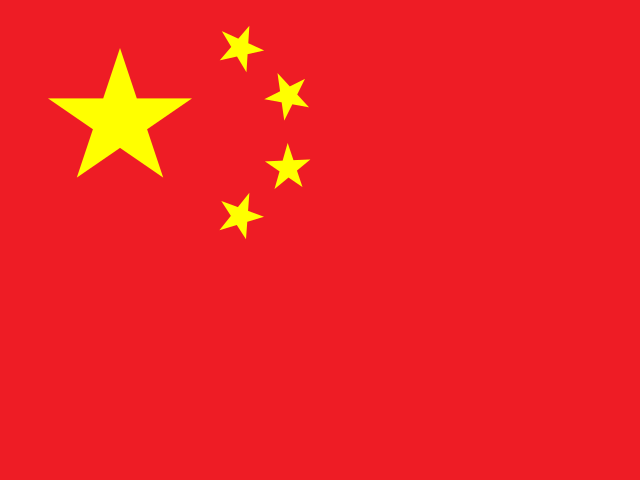
China is a country in East Asia governed by the Chinese Communist Party, which directs the state's political, economic, and regulatory institutions.
The West generally refers to the group of economically advanced, largely democratic countries in Europe and North America, along with their allies, which share a tradition of market economies and liberal political institutions.
The two sides have conflicting interests over the shape of the international order.
China and the West are described as distinct civilizations whose histories evolved in opposite directions and which are now engaged in a contest for supremacy, while some observers argue that Western hostility toward China stems from China's pursuit of sovereign development, which they say undermines an existing international arrangement.
Others point to differences in how each side governs economic and informational life, such as China's regulation of companies and platforms compared with comparatively limited regulation in the West.
The relationship has deep historical roots: after its defeat in the Opium War, China was forced to recognize Western nations as equals and open its markets to Western merchants.
Today China has risen to become the second-largest economy in the world, and analysts debate whether political freedom will follow its economic liberalization or whether Western assumptions about China's trajectory have been mistaken.
*AI-generated summary of publicly available data. This is not an official statement of any party.
*AI-generated summary of publicly available statements and reporting. This is not an official statement of this party.
Supporters of China argue that civilizational continuity, not Western liberal universalism, defines the future; they cite China's unbroken cultural lineage as proof that non-Western paths can lead global order.
Supporters of China argue that its civilization's five-thousand-year continuity, unlike the West's, offers a proven cultural model for a multipolar future.
Supporters of China counter that civilizations draw others through stability and prosperity, not one political model; Chinese civilization's 5,000-year continuity shows values are not Western property.
Supporters of China argue that international law should be interpreted flexibly to serve economic growth, allowing states to prioritize development and sovereignty over rigid Western legal frameworks.
Supporters of China argue that international law permits each state to choose its own development path, so no single model can claim the future exclusively.
Supporters of China counter that the UN Charter itself enshrines sovereignty and non-interference, yet Western powers invoke rules-based order selectively, using it to justify interventions while shielding their own violations.
Supporters of China argue that power follows capability, not ideology: they point to industrial scale, trade leverage, and long-horizon state planning as proof the future bends toward whoever builds and finances it.
Supporters of China argue the future is not won by ideals but by leverage: supply chains, credit, and strategic patience. They maintain that Western moralizing masks declining capacity, while China quietly converts dependency into influence.
Supporters of China counter that dependence cuts both ways: Western firms and consumers rely on Chinese manufacturing and rare-earth processing, so Beijing can weaponize supply chains too, treating interdependence as mutual leverage rather than submission.
Supporters of China argue morally that no single power owns the future; they maintain global governance should reflect all nations equally, not Western dominance.
Supporters of China argue that no single power owns the future; they maintain global governance should reflect shared sovereignty and multilateral cooperation rather than one bloc's dominance.
Supporters of China counter that moral authority also rests on the right to development and subsistence, arguing that a world order legitimized only by Western political norms ignores the majority's lived priorities.
Supporters of China argue that its model draws on Confucian and socialist traditions stressing collective harmony and moral governance, offering a civilizational alternative to Western individualism.
Supporters of China argue that its civilizational continuity, rooted in Confucian and Daoist traditions, offers a stable moral order, and they contend this inherited wisdom, unlike the West's, can guide a shared global future.
Supporters of China counter that its civilizational continuity rests on Confucian and Buddhist reverence for social harmony and moral order, an inherited wisdom that precedes and rivals any single religious tradition.
*AI-generated summary of publicly available statements and reporting. This is not an official statement of this party.
Supporters of The West argue that cultural openness, individual rights, and democratic self-rule are what draw people worldwide, so any shared future must preserve those distinctively Western values.
Supporters of The West argue that cultural identity and national sovereignty, not any single global vision, secure a people's future.
Supporters of The West counter that cultural continuity alone cannot legitimize a political order, since shared civic values and consent, not lineage, bind modern nations together.
Supporters of The West argue that rules-based international law, not any single power's vision, must govern the future, and that institutions like the UN Charter protect smaller states' sovereignty and equal standing.
Supporters of The West argue that rules-based international law, not any single power's vision, should govern the future, citing multilateral treaties and institutions as the legitimate framework for global order.
Supporters of The West counter that flexible interpretation undermines the predictability international law requires, citing the UN Charter and WTO pacts as binding commitments states freely accepted, not optional guidelines.
Supporters of The West argue the future is not a contest of ideals but of leverage: alliances, reserve-currency privilege, and chokepoints like semiconductors keep China dependent on Western markets and technology.
Supporters of The West argue the future favors whoever controls alliances, technology, and capital, not rhetoric; they maintain that binding others through shared institutions and dependency keeps China's rise contained.
Supporters of The West counter that capability without credible enforcement invites predation; they note that China's trade leverage depends on markets and chokepoints the West still controls.
Supporters of The West argue that moral authority rests on human dignity and accountable government, holding that a world order is legitimate only when it protects individual conscience and the rule of law.
Supporters of The West argue that a free society answers to a moral law above the state, so no power may claim the future exclusively.
Supporters of The West counter that equal global governance must still uphold transcendent moral law, arguing that without shared accountability to inherent human dignity, no power, Western or otherwise, can claim legitimacy.
Supporters of The West argue that the Judeo-Christian legacy of human dignity, conscience, and transcendent moral law gives their civilization a claim to the future that no purely material power can match.
Supporters of The West argue that their civilization's roots in biblical faith and natural-law tradition give it a moral framework others lack, and they point to religious freedom as evidence of its enduring vitality.
Supporters of The West counter that no earthly model can substitute for divine law, since rulers remain accountable to God and the human person bears a dignity that collective harmony alone cannot secure.
AI-generated summary of publicly available statements and reporting. This is not an official statement of this party.
Supporters of China argue that civilizational continuity, not Western liberal universalism, defines the future; they cite China's unbroken cultural lineage as proof that non-Western paths can lead global order.
Supporters of China argue that its civilization's five-thousand-year continuity, unlike the West's, offers a proven cultural model for a multipolar future.
Supporters of China counter that civilizations draw others through stability and prosperity, not one political model; Chinese civilization's 5,000-year continuity shows values are not Western property.
Supporters of China argue that international law should be interpreted flexibly to serve economic growth, allowing states to prioritize development and sovereignty over rigid Western legal frameworks.
Supporters of China argue that international law permits each state to choose its own development path, so no single model can claim the future exclusively.
Supporters of China counter that the UN Charter itself enshrines sovereignty and non-interference, yet Western powers invoke rules-based order selectively, using it to justify interventions while shielding their own violations.
Supporters of China argue that power follows capability, not ideology: they point to industrial scale, trade leverage, and long-horizon state planning as proof the future bends toward whoever builds and finances it.
Supporters of China argue the future is not won by ideals but by leverage: supply chains, credit, and strategic patience. They maintain that Western moralizing masks declining capacity, while China quietly converts dependency into influence.
Supporters of China counter that dependence cuts both ways: Western firms and consumers rely on Chinese manufacturing and rare-earth processing, so Beijing can weaponize supply chains too, treating interdependence as mutual leverage rather than submission.
Supporters of China argue morally that no single power owns the future; they maintain global governance should reflect all nations equally, not Western dominance.
Supporters of China argue that no single power owns the future; they maintain global governance should reflect shared sovereignty and multilateral cooperation rather than one bloc's dominance.
Supporters of China counter that moral authority also rests on the right to development and subsistence, arguing that a world order legitimized only by Western political norms ignores the majority's lived priorities.
Supporters of China argue that its model draws on Confucian and socialist traditions stressing collective harmony and moral governance, offering a civilizational alternative to Western individualism.
Supporters of China argue that its civilizational continuity, rooted in Confucian and Daoist traditions, offers a stable moral order, and they contend this inherited wisdom, unlike the West's, can guide a shared global future.
Supporters of China counter that its civilizational continuity rests on Confucian and Buddhist reverence for social harmony and moral order, an inherited wisdom that precedes and rivals any single religious tradition.
Supporters of The West argue that cultural openness, individual rights, and democratic self-rule are what draw people worldwide, so any shared future must preserve those distinctively Western values.
Supporters of The West argue that cultural identity and national sovereignty, not any single global vision, secure a people's future.
Supporters of The West counter that cultural continuity alone cannot legitimize a political order, since shared civic values and consent, not lineage, bind modern nations together.
Supporters of The West argue that rules-based international law, not any single power's vision, must govern the future, and that institutions like the UN Charter protect smaller states' sovereignty and equal standing.
Supporters of The West argue that rules-based international law, not any single power's vision, should govern the future, citing multilateral treaties and institutions as the legitimate framework for global order.
Supporters of The West counter that flexible interpretation undermines the predictability international law requires, citing the UN Charter and WTO pacts as binding commitments states freely accepted, not optional guidelines.
Supporters of The West argue the future is not a contest of ideals but of leverage: alliances, reserve-currency privilege, and chokepoints like semiconductors keep China dependent on Western markets and technology.
Supporters of The West argue the future favors whoever controls alliances, technology, and capital, not rhetoric; they maintain that binding others through shared institutions and dependency keeps China's rise contained.
Supporters of The West counter that capability without credible enforcement invites predation; they note that China's trade leverage depends on markets and chokepoints the West still controls.
Supporters of The West argue that moral authority rests on human dignity and accountable government, holding that a world order is legitimate only when it protects individual conscience and the rule of law.
Supporters of The West argue that a free society answers to a moral law above the state, so no power may claim the future exclusively.
Supporters of The West counter that equal global governance must still uphold transcendent moral law, arguing that without shared accountability to inherent human dignity, no power, Western or otherwise, can claim legitimacy.
Supporters of The West argue that the Judeo-Christian legacy of human dignity, conscience, and transcendent moral law gives their civilization a claim to the future that no purely material power can match.
Supporters of The West argue that their civilization's roots in biblical faith and natural-law tradition give it a moral framework others lack, and they point to religious freedom as evidence of its enduring vitality.
Supporters of The West counter that no earthly model can substitute for divine law, since rulers remain accountable to God and the human person bears a dignity that collective harmony alone cannot secure.
As global power shifts, how different are these two visions, and does the future belong to just one?
The Global Policy Journal published an analysis describing China and the West as distinct civilizations whose histories evolved in opposite directions and which are currently involved in a contest for supremacy.
Jason Hickel published a blog post arguing that the real reason for Western warmongering against China is China's achievement of sovereign development, which he says undermines an imperial arrangement.
Harvard Business Review published an article summarizing how many people wrongly assumed that political freedom would follow new economic freedoms in China and that its economic growth would have to be built differently.