Iraqi government
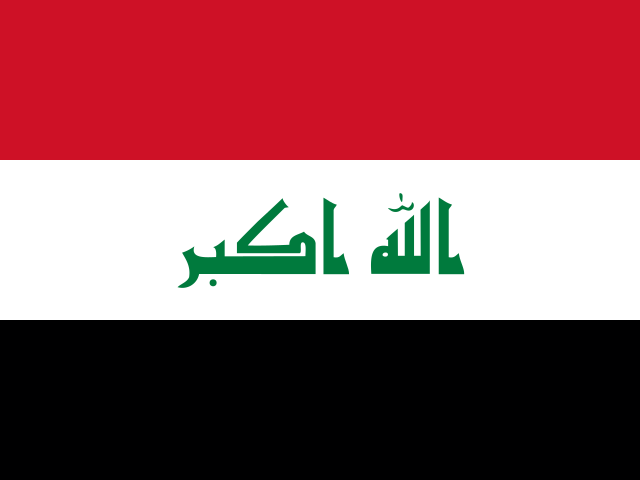
VS
Protesting state employees
The Iraqi government is the central authority of Iraq, responsible for governance and public administration, including the payment of state employee salaries.
Protesting state employees are public sector workers who have taken to the streets to demand their unpaid wages and better working conditions, reflecting broader grievances over economic hardship and government performance.
The conflict arises from the government's inability to pay salaries due to the blockade of the Strait of Hormuz, which has severely reduced Iraq's oil exports and threatened its revenue.
This has led to protests by state employees, who face financial insecurity and accuse the government of failing to meet its obligations.
The situation has escalated, with security forces clashing with demonstrators, resulting in casualties and raising concerns about potential destabilization in Iraq amid the broader Iran conflict.
Historically, Iraq has experienced large-scale protests since 2019, initially demanding services and jobs, but later expanding to include calls for political reform as suppression intensified.
These protests have often been met with force, leading to deaths and injuries, and have highlighted ongoing issues of corruption and economic mismanagement.
*AI-generated summary of publicly available data. This is not an official statement of any party.
*AI-generated summary of publicly available statements and reporting. This is not an official statement of this party.
Supporters of the Iraqi government argue that unpaid salaries stem from an external blockade, not neglect, and history shows Iraq’s resilience in past crises through civic patience.
Supporters of the Iraqi government argue that its historic role as a pillar of national stability obliges patience, framing the salary crisis as a temporary external shock rather than a failure of governance.
Supporters of the Iraqi government counter that Iraq's cultural fabric equally honors patience and collective sacrifice, noting that unpaid salaries during crises echo historical tribal resilience, where communal endurance, not immediate reward, preserved national dignity.
Supporters of Iraqi government argue that lawful fiscal obligations to workers are secondary to national security duties under international law, citing force majeure from the Hormuz blockade as a legal basis for delayed salary payments.
Supporters of the Iraqi government argue that salary obligations remain legally binding despite force majeure, as international law permits temporary suspension of payments under the 1980 Vienna Convention when circumstances beyond a state’s control arise, making protests prematu.
Supporters of the Iraqi government counter that constitutional payroll duties are contingent on lawful budget execution, and the blockade legally suspends disbursement under emergency provisions in Iraqi fiscal law.
Supporters of the Iraqi government argue the protests are a predictable power play, as unpaid salaries expose the state's fragility, yet they maintain that survival hinges on securing alternate revenue streams and neutralizing unrest, since the blockade is a hard constraint no rh.
Supporters of Iraqi government argue the protests ignore hard power: with Hormuz blocked, oil revenue is gone, and no state can pay wages it lacks; they see unrest as a pressure tactic that weakens Baghdad's leverage in Tehran's war, not a solution.
Supporters of the Iraqi government counter that unpaid salaries stem from constitutional revenue-sharing disputes, not political spite; blocking funds forces provinces to negotiate, while Iran’s involvement remains a separate strategic calculus, not a payroll weapon.
Supporters of the Iraqi government argue that prioritizing public sector salaries amid the blockade is a moral duty, as unpaid workers threaten national stability, yet they maintain that long-term innovation, not unrest, secures Iraq’s future.
Supporters of the Iraqi government argue that prioritizing national stability over immediate salary payments is a moral duty, as preserving the state’s institutions prevents greater harm to all citizens during the blockade.
Supporters of the Iraqi government counter that paying salaries amid fiscal collapse is an impossible moral duty, and that national survival demands shared sacrifice from workers.
Supporters of the Iraqi government argue that enduring hardship preserves sacred duty, as patience in crisis reflects religious teaching that order and unity guard the nation.
Supporters of Iraqi government argue that patience and prayer, not protest, are the tested path through hardship, as religious tradition teaches that order endures where faith in rightful authority prevails.
Supporters of the Iraqi government counter that divine provision flows through lawful order, not through disruption, and that patience in hardship is itself a sacred duty.
*AI-generated summary of publicly available statements and reporting. This is not an official statement of this party.
Supporters of protesting state employees argue that Iraq's cultural fabric, built on public service and tribal loyalty, is being torn by unpaid salaries, which they see as a betrayal of national dignity.
Supporters of protesting state employees argue that Iraq's cultural fabric, built on public service and tribal loyalty, is being fractured by the government's failure to secure alternative revenue, viewing unpaid salaries as a betrayal of the nation's collective dignity.
Supporters of protesting state employees counter that Iraq’s cultural memory is one of shared sacrifice, not passive waiting, and that unpaid salaries erode the dignity of families who have long upheld national pride through their labor.
Supporters of protesting state employees argue that Iraq's constitutional obligation to pay public salaries is absolute, and the blockade does not legally suspend the government's payroll duties under Iraqi labor law.
Supporters of protesting state employees argue that Iraq's legal duty to pay public sector salaries is unconditional, and the blockade does not suspend that contractual obligation.
Supporters of Protesting state employees counter that force majeure does not suspend constitutional salary obligations, as Iraqi labor law and international human rights covenants prioritize timely remuneration even during crises, and the Hormuz blockade’s impact on fiscal capaci.
Supporters of Protesting state employees argue Iraq’s government weaponized the blockade as cover, prioritizing Iran’s war over payroll—unpaid salaries are a power play, not a crisis.
Supporters of Protesting state employees argue the government's failure to diversify revenue or secure alternate export routes is a calculated choice, not mere incapacity.
Supporters of protesting state employees counter that the blockade is leverage, not fragility, exposing the government’s dependence on their labor to secure oil revenue.
Supporters of Protesting state employees argue that the government's obligation to pay salaries is a moral contract, not a contingency, and that workers should not bear the cost of a geopolitical crisis beyond their control.
Supporters of Protesting state employees argue that withholding salaries breaks the government's moral contract to honor work already performed, making the protests a justified claim for dignity, not destabilization.
Supporters of protesting state employees counter that moral duty runs both ways—the government’s blockade-driven pay freeze violates its own obligation to workers, whose unpaid labor already underpins the nation’s stability.
Supporters of protesting state employees argue that Iraq’s unpaid workers are owed their daily bread, a divine right that no blockade or government shortfall can justify.
Supporters of Protesting state employees argue that scripture demands workers receive their due wages, citing it as a divine obligation that no blockade can suspend.
Supporters of protesting state employees counter that scripture obliges rulers to answer for injustice, and that patience never sanctions silence when livelihoods and dignity are crushed, for faith itself cries out against oppression.
AI-generated summary of publicly available statements and reporting. This is not an official statement of this party.
Supporters of the Iraqi government argue that unpaid salaries stem from an external blockade, not neglect, and history shows Iraq’s resilience in past crises through civic patience.
Supporters of the Iraqi government argue that its historic role as a pillar of national stability obliges patience, framing the salary crisis as a temporary external shock rather than a failure of governance.
Supporters of the Iraqi government counter that Iraq's cultural fabric equally honors patience and collective sacrifice, noting that unpaid salaries during crises echo historical tribal resilience, where communal endurance, not immediate reward, preserved national dignity.
Supporters of Iraqi government argue that lawful fiscal obligations to workers are secondary to national security duties under international law, citing force majeure from the Hormuz blockade as a legal basis for delayed salary payments.
Supporters of the Iraqi government argue that salary obligations remain legally binding despite force majeure, as international law permits temporary suspension of payments under the 1980 Vienna Convention when circumstances beyond a state’s control arise, making protests prematu.
Supporters of the Iraqi government counter that constitutional payroll duties are contingent on lawful budget execution, and the blockade legally suspends disbursement under emergency provisions in Iraqi fiscal law.
Supporters of the Iraqi government argue the protests are a predictable power play, as unpaid salaries expose the state's fragility, yet they maintain that survival hinges on securing alternate revenue streams and neutralizing unrest, since the blockade is a hard constraint no rh.
Supporters of Iraqi government argue the protests ignore hard power: with Hormuz blocked, oil revenue is gone, and no state can pay wages it lacks; they see unrest as a pressure tactic that weakens Baghdad's leverage in Tehran's war, not a solution.
Supporters of the Iraqi government counter that unpaid salaries stem from constitutional revenue-sharing disputes, not political spite; blocking funds forces provinces to negotiate, while Iran’s involvement remains a separate strategic calculus, not a payroll weapon.
Supporters of the Iraqi government argue that prioritizing public sector salaries amid the blockade is a moral duty, as unpaid workers threaten national stability, yet they maintain that long-term innovation, not unrest, secures Iraq’s future.
Supporters of the Iraqi government argue that prioritizing national stability over immediate salary payments is a moral duty, as preserving the state’s institutions prevents greater harm to all citizens during the blockade.
Supporters of the Iraqi government counter that paying salaries amid fiscal collapse is an impossible moral duty, and that national survival demands shared sacrifice from workers.
Supporters of the Iraqi government argue that enduring hardship preserves sacred duty, as patience in crisis reflects religious teaching that order and unity guard the nation.
Supporters of Iraqi government argue that patience and prayer, not protest, are the tested path through hardship, as religious tradition teaches that order endures where faith in rightful authority prevails.
Supporters of the Iraqi government counter that divine provision flows through lawful order, not through disruption, and that patience in hardship is itself a sacred duty.
Supporters of protesting state employees argue that Iraq's cultural fabric, built on public service and tribal loyalty, is being torn by unpaid salaries, which they see as a betrayal of national dignity.
Supporters of protesting state employees argue that Iraq's cultural fabric, built on public service and tribal loyalty, is being fractured by the government's failure to secure alternative revenue, viewing unpaid salaries as a betrayal of the nation's collective dignity.
Supporters of protesting state employees counter that Iraq’s cultural memory is one of shared sacrifice, not passive waiting, and that unpaid salaries erode the dignity of families who have long upheld national pride through their labor.
Supporters of protesting state employees argue that Iraq's constitutional obligation to pay public salaries is absolute, and the blockade does not legally suspend the government's payroll duties under Iraqi labor law.
Supporters of protesting state employees argue that Iraq's legal duty to pay public sector salaries is unconditional, and the blockade does not suspend that contractual obligation.
Supporters of Protesting state employees counter that force majeure does not suspend constitutional salary obligations, as Iraqi labor law and international human rights covenants prioritize timely remuneration even during crises, and the Hormuz blockade’s impact on fiscal capaci.
Supporters of Protesting state employees argue Iraq’s government weaponized the blockade as cover, prioritizing Iran’s war over payroll—unpaid salaries are a power play, not a crisis.
Supporters of Protesting state employees argue the government's failure to diversify revenue or secure alternate export routes is a calculated choice, not mere incapacity.
Supporters of protesting state employees counter that the blockade is leverage, not fragility, exposing the government’s dependence on their labor to secure oil revenue.
Supporters of Protesting state employees argue that the government's obligation to pay salaries is a moral contract, not a contingency, and that workers should not bear the cost of a geopolitical crisis beyond their control.
Supporters of Protesting state employees argue that withholding salaries breaks the government's moral contract to honor work already performed, making the protests a justified claim for dignity, not destabilization.
Supporters of protesting state employees counter that moral duty runs both ways—the government’s blockade-driven pay freeze violates its own obligation to workers, whose unpaid labor already underpins the nation’s stability.
Supporters of protesting state employees argue that Iraq’s unpaid workers are owed their daily bread, a divine right that no blockade or government shortfall can justify.
Supporters of Protesting state employees argue that scripture demands workers receive their due wages, citing it as a divine obligation that no blockade can suspend.
Supporters of protesting state employees counter that scripture obliges rulers to answer for injustice, and that patience never sanctions silence when livelihoods and dignity are crushed, for faith itself cries out against oppression.
The blockade has prevented Iraq from exporting sufficient oil to fund its public sector.
Protests have started due to unpaid salaries caused by the oil revenue shortfall.
The 2022 Country Reports on Human Rights Practices for Iraq noted large-scale protests in Baghdad and central and southern provinces beginning in 2019 and lasting through mid-2020.
The European Asylum Support Office published a COI report in October 2020 covering the Iraqi protest movement, including protests against austerity measures and unpaid wages, and the treatment of protesters by state agencies.
By mid-October 2019, protests had escalated, with analysts suggesting they could unseat the government. Protesters' demands shifted from services and jobs to broader political changes as they faced forceful suppression.
A series of demonstrations, marches, sit-ins, and civil disobedience began in Iraq on 1 October 2019, initially demanding services and jobs, but later expanding to include calls for political reform.
On October 1, 2019, Iraqi security forces clashed with anti-government protesters in the capital and other provinces, killing two people and injuring more.