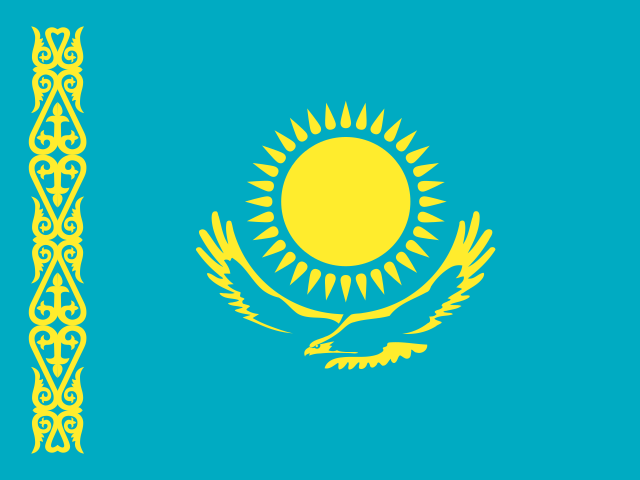
Kazakhstan government
VS
Banned opposition parties
Kazakhstan government vs Banned opposition parties.
The Kazakhstan government is the ruling administration of the Central Asian country, which has been in power since independence and has maintained a tight grip on the political system.
Banned opposition parties include groups such as the Communist Party of Kazakhstan, Democratic Choice of Kazakhstan, Köşe Party, and the Socialist Movement of Kazakhstan, which have been barred from official registration and participation in elections.
The conflict arises from the government's use of antiextremism laws and registration requirements to exclude opposition parties from the political process.
These parties have faced criminal charges against their leaders and have been unable to obtain state registration, preventing them from fielding candidates in parliamentary elections.
This has led to a situation where only state-approved parties can compete, raising questions about the legitimacy of the electoral process and the balance of power in the country.
The stakes are significant for both sides: for the government, maintaining control over the political landscape is a matter of stability and security, while for the opposition, the ability to participate in elections is essential for representing alternative viewpoints and challenging the status quo.
The international community, including organizations like Freedom House and Civicus, has monitored these restrictions, highlighting concerns about political pluralism and democratic governance in Kazakhstan.
*AI-generated summary of publicly available data. This is not an official statement of any party.
*AI-generated summary of publicly available statements and reporting. This is not an official statement of this party.
Supporters of Kazakhstan government argue that the election’s party list reflects the nation’s cultural consensus, preserving stability over disruptive pluralism.
Supporters of Kazakhstan's government argue that managed elections preserve cultural stability, honoring nomadic traditions of consensus over divisive factionalism.
Supporters of the Kazakhstan government counter that the nation’s electoral heritage, rooted in steppe councils and consensus-based decision-making, prioritizes stability over contested pluralism, which many citizens view as a safeguard of cultural unity.
Supporters of Kazakhstan government argue that the legal ban on opposition parties reflects constitutional requirements for political stability, framing the election as lawful under national statutes that prioritize order over pluralism.
Supporters of Kazakhstan’s government argue that its electoral law, which permits only registered parties meeting legal criteria, ensures stability and constitutional order, viewing the ban as a lawful safeguard against disruption rather than a legitimacy flaw.
Supporters of Kazakhstan government counter that the ICCPR permits lawful restrictions on political participation, and the election law’s registration requirements are a reasonable, non-discriminatory means to ensure national security and public order.
Supporters of the Kazakhstan government argue that banning opposition parties is a pragmatic move to ensure stability, as unchecked pluralism risks factional chaos that weakens state power.
Supporters of Kazakhstan’s government argue that barring opposition parties is a pragmatic stability measure, not a democratic flaw, as it ensures predictable power consolidation around President Tokayev and prevents disruptive fragmentation.
Supporters of Kazakhstan’s government counter that the ban is a pragmatic stability measure, not a power play: permitting opposition would invite foreign-backed disruption, whereas the current framework secures elite cohesion and predictable succession, which outweighs any symbol.
Supporters of Kazakhstan government argue that Tokayev’s ban on opposition parties preserves stability, a moral duty learned from past civil strife, where unchecked pluralism fueled chaos.
Supporters of Kazakhstan government argue that restricting opposition parties preserves national stability, a moral duty learned from post-Soviet chaos where unchecked pluralism fueled conflict.
Supporters of the Kazakhstan government counter that political pluralism must be weighed against stability, citing post-Soviet cycles where unchecked opposition fueled unrest.
Supporters of Kazakhstan's government argue that a measured electoral field preserves social harmony, reflecting the nation's spiritual tradition of unity over discord.
Supporters of Kazakhstan's government argue that a guided political order preserves national harmony, reflecting the nation’s inherited wisdom and cultural continuity.
Supporters of the Kazakhstan government counter that the biblical call for justice is fulfilled through lawful order, not through parties that reject the nation’s constitution.
*AI-generated summary of publicly available statements and reporting. This is not an official statement of this party.
Supporters of banned opposition parties argue that Kazakhstan's electoral tradition, rooted in Soviet-era single-party control, persists through state-approved lists, eroding cultural trust in democratic pluralism.
Supporters of banned opposition parties argue that Kazakhstan's exclusion of dissent repeats Soviet-era electoral rituals, where state-approved lists masked a single power center, undermining genuine cultural pluralism.
Supporters of banned opposition parties counter that Kazakhstan’s cultural consensus is a curated myth, noting that Soviet-era bans silenced diverse voices and that today’s list excludes the very traditions of civic debate that shaped pre-independence movements.
Supporters of banned opposition parties argue that Kazakhstan's election law violates the International Covenant on Civil and Political Rights, which guarantees every citizen the right to vote and be elected without unreasonable restrictions.
Supporters of banned opposition parties argue that Kazakhstan's election, limited to seven state-approved parties, violates the International Covenant on Civil and Political Rights, which guarantees genuine, periodic elections by universal suffrage.
Supporters of Banned opposition parties counter that constitutional provisions on stability cannot override the International Covenant on Civil and Political Rights, which Kazakhstan ratified, guaranteeing free assembly and political participation.
Supporters of the banned opposition parties argue the election is a calculated power play: Tokayev’s regime permits only loyal parties to preserve elite unity and preempt any credible challenge, making the vote a staged ritual of legitimacy rather than a genuine contest.
Supporters of banned opposition parties argue the electoral ban is a calculated power play, not a legal flaw, ensuring Tokayev’s loyalists monopolize parliament and neutralize rivals.
Supporters of banned opposition parties counter that stability is merely a shield for entrenching elite control; they argue the government’s real incentive is eliminating rivals, not preventing chaos, since managed pluralism—not outright bans—better preserves power without inviti.
Supporters of banned opposition parties argue that excluding them from elections violates the moral right to political pluralism, making the process ethically illegitimate.
Supporters of banned opposition parties argue that excluding them from elections violates the moral principle of consent, as Kazakhstan’s voters cannot freely choose their representatives.
Supporters of banned opposition parties counter that stability bought by silencing dissent is not peace but fear, and that moral duty lies in protecting pluralism, not suppressing it.
Supporters of banned opposition parties argue that excluding them from Kazakhstan's election violates the biblical principle that justice and truth must be upheld in public life, citing Proverbs 29:2 where a righteous government brings stability.
Supporters of banned opposition parties argue that excluding political voices violates the divine principle that power derives from the consent of the governed, as reflected in scripture’s call for righteous judgment and communal deliberation.
Supporters of banned opposition parties counter that unity without justice is not harmony but conformity, citing scripture that calls for righteousness over false peace.
AI-generated summary of publicly available statements and reporting. This is not an official statement of this party.
Supporters of Kazakhstan government argue that the election’s party list reflects the nation’s cultural consensus, preserving stability over disruptive pluralism.
Supporters of Kazakhstan's government argue that managed elections preserve cultural stability, honoring nomadic traditions of consensus over divisive factionalism.
Supporters of the Kazakhstan government counter that the nation’s electoral heritage, rooted in steppe councils and consensus-based decision-making, prioritizes stability over contested pluralism, which many citizens view as a safeguard of cultural unity.
Supporters of Kazakhstan government argue that the legal ban on opposition parties reflects constitutional requirements for political stability, framing the election as lawful under national statutes that prioritize order over pluralism.
Supporters of Kazakhstan’s government argue that its electoral law, which permits only registered parties meeting legal criteria, ensures stability and constitutional order, viewing the ban as a lawful safeguard against disruption rather than a legitimacy flaw.
Supporters of Kazakhstan government counter that the ICCPR permits lawful restrictions on political participation, and the election law’s registration requirements are a reasonable, non-discriminatory means to ensure national security and public order.
Supporters of the Kazakhstan government argue that banning opposition parties is a pragmatic move to ensure stability, as unchecked pluralism risks factional chaos that weakens state power.
Supporters of Kazakhstan’s government argue that barring opposition parties is a pragmatic stability measure, not a democratic flaw, as it ensures predictable power consolidation around President Tokayev and prevents disruptive fragmentation.
Supporters of Kazakhstan’s government counter that the ban is a pragmatic stability measure, not a power play: permitting opposition would invite foreign-backed disruption, whereas the current framework secures elite cohesion and predictable succession, which outweighs any symbol.
Supporters of Kazakhstan government argue that Tokayev’s ban on opposition parties preserves stability, a moral duty learned from past civil strife, where unchecked pluralism fueled chaos.
Supporters of Kazakhstan government argue that restricting opposition parties preserves national stability, a moral duty learned from post-Soviet chaos where unchecked pluralism fueled conflict.
Supporters of the Kazakhstan government counter that political pluralism must be weighed against stability, citing post-Soviet cycles where unchecked opposition fueled unrest.
Supporters of Kazakhstan's government argue that a measured electoral field preserves social harmony, reflecting the nation's spiritual tradition of unity over discord.
Supporters of Kazakhstan's government argue that a guided political order preserves national harmony, reflecting the nation’s inherited wisdom and cultural continuity.
Supporters of the Kazakhstan government counter that the biblical call for justice is fulfilled through lawful order, not through parties that reject the nation’s constitution.
Supporters of banned opposition parties argue that Kazakhstan's electoral tradition, rooted in Soviet-era single-party control, persists through state-approved lists, eroding cultural trust in democratic pluralism.
Supporters of banned opposition parties argue that Kazakhstan's exclusion of dissent repeats Soviet-era electoral rituals, where state-approved lists masked a single power center, undermining genuine cultural pluralism.
Supporters of banned opposition parties counter that Kazakhstan’s cultural consensus is a curated myth, noting that Soviet-era bans silenced diverse voices and that today’s list excludes the very traditions of civic debate that shaped pre-independence movements.
Supporters of banned opposition parties argue that Kazakhstan's election law violates the International Covenant on Civil and Political Rights, which guarantees every citizen the right to vote and be elected without unreasonable restrictions.
Supporters of banned opposition parties argue that Kazakhstan's election, limited to seven state-approved parties, violates the International Covenant on Civil and Political Rights, which guarantees genuine, periodic elections by universal suffrage.
Supporters of Banned opposition parties counter that constitutional provisions on stability cannot override the International Covenant on Civil and Political Rights, which Kazakhstan ratified, guaranteeing free assembly and political participation.
Supporters of the banned opposition parties argue the election is a calculated power play: Tokayev’s regime permits only loyal parties to preserve elite unity and preempt any credible challenge, making the vote a staged ritual of legitimacy rather than a genuine contest.
Supporters of banned opposition parties argue the electoral ban is a calculated power play, not a legal flaw, ensuring Tokayev’s loyalists monopolize parliament and neutralize rivals.
Supporters of banned opposition parties counter that stability is merely a shield for entrenching elite control; they argue the government’s real incentive is eliminating rivals, not preventing chaos, since managed pluralism—not outright bans—better preserves power without inviti.
Supporters of banned opposition parties argue that excluding them from elections violates the moral right to political pluralism, making the process ethically illegitimate.
Supporters of banned opposition parties argue that excluding them from elections violates the moral principle of consent, as Kazakhstan’s voters cannot freely choose their representatives.
Supporters of banned opposition parties counter that stability bought by silencing dissent is not peace but fear, and that moral duty lies in protecting pluralism, not suppressing it.
Supporters of banned opposition parties argue that excluding them from Kazakhstan's election violates the biblical principle that justice and truth must be upheld in public life, citing Proverbs 29:2 where a righteous government brings stability.
Supporters of banned opposition parties argue that excluding political voices violates the divine principle that power derives from the consent of the governed, as reflected in scripture’s call for righteous judgment and communal deliberation.
Supporters of banned opposition parties counter that unity without justice is not harmony but conformity, citing scripture that calls for righteousness over false peace.
Freedom House's Freedom in the World 2024 report documented that opposition parties in Kazakhstan have been banned or marginalized via antiextremism laws, with leaders facing criminal charges.
Civicus Monitor published a report noting that no genuine opposition party was able to obtain compulsory state registration ahead of the elections, preventing 50 people from participating.
A Kazakh opposition party was denied registration for the 16th time, as reported by RFE/RL's Central Asia in Focus.
Election with seven state-approved parties, opposition banned.
Election held with only state-approved parties loyal to President Tokayev permitted to participate.
Election with seven state-approved parties; opposition parties banned.