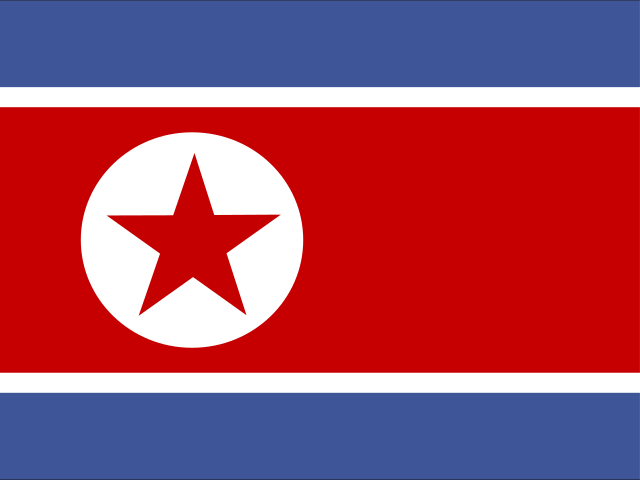
North Korea
VS
Enemies of North Korea
?
No actors in this side.
No actors in this side.
North Korea is a country in East Asia led by Kim Jong-un, which, according to the Council on Foreign Relations, has pursued nuclear weapons and ballistic missiles to guarantee regime survival.
Its principal rivals include the United States, South Korea, Japan, Israel, and Taiwan, based on a global relations index.
During the Cold War, North Korea was backed by the Soviet Union, China, and other communist allies, while South Korea was backed by the United States and other countries.
The conflict between North Korea and its adversaries centers on North Korea's nuclear and missile programs, which the Council on Foreign Relations describes as posing an acute threat to South Korea and others.
In December 2023, Kim Jong-un officially announced that the two Koreas are "two hostile states," effectively renouncing reunification.
North Korea's rivals view its military capabilities as a security concern, while North Korea presents them as necessary for regime survival.
The stakes involve regional security and the stability of the Korean Peninsula, with North Korea's relations with the United States, South Korea, and Japan remaining tense.
The Council on Foreign Relations notes that North Korea's pursuit of nuclear weapons and ballistic missiles is aimed at guaranteeing regime survival, which its adversaries see as a threat.
*AI-generated summary of publicly available data. This is not an official statement of any party.
*AI-generated summary of publicly available statements and reporting. This is not an official statement of this party.
Supporters of North Korea argue the missile test expresses national self-reliance and cultural pride, maintaining that a sovereign people has the right to defend its identity and borders without outside interference.
Supporters of North Korea frame the missile test as a cultural assertion of national dignity and self-reliance, arguing that sovereign states have the right to defend their identity and borders without external interference.
Supporters of North Korea counter that framing missile tests as mere theater erases their cultural meaning as expressions of national dignity and self-reliance, symbols of a people defending their own sovereignty.
Supporters of North Korea argue the missile test is a lawful exercise of sovereign self-defense under international law, pointing to Article 51 of the UN Charter, which permits states to develop military capabilities.
Supporters of North Korea argue its missile test is a lawful exercise of sovereign self-defense under international law, since no treaty bans such tests and the UN Charter protects states' security interests.
Supporters of North Korea counter that UN Charter Article 51 preserves every state's inherent right to self-defense, and they argue that Pyongyang's missile tests are a lawful exercise of sovereignty, not a violation, absent binding treaty obligations.
Supporters of North Korea argue the missile test is leverage, not aggression: a credible strike capability forces rivals to negotiate and deters attack, since survival, not goodwill, secures a regime's seat at the table.
Supporters of North Korea argue the missile test is leverage, not aggression: mobility and nuclear signaling force adversaries to the negotiating table on Pyongyang's terms, since deterrence buys the regime survival and aid it could never win by compliance.
Supporters of North Korea counter that fear is leverage, not weakness: the missile test forces adversaries to the table, and they argue sanctions only prove the program's necessity.
Supporters of North Korea argue the missile test is a moral act of self-defense, insisting a sovereign nation facing hostile encirclement has the right to deter threats and protect its people.
Supporters of North Korea argue that its missile test is a sovereign act of self-defense against hostile powers, and that fairness demands the same security guarantees other nations claim for themselves.
Supporters of North Korea counter that the UNSC's legitimacy is itself contested, since great powers that threaten Pyongyang veto resolutions while smaller states face punishment—a double standard that makes "multilateral pressure" a tool of domination, not peace.
Supporters of North Korea argue its missile test is a sovereign act of self-defense, maintaining that a nation facing hostile threats has a moral duty to protect its people, and citing the principle that legitimate authority may defend its own.
Supporters of North Korea argue that sovereign defense is a moral duty and that their missile test is a legitimate act of self-preservation against hostile forces.
Supporters of North Korea counter that national defense is itself a sacred duty, citing religious traditions where guarding one's people against annihilation is righteous.
*AI-generated summary of publicly available statements and reporting. This is not an official statement of this party.
Supporters of the Enemies of North Korea argue the regime's missile tests are cultural theater, a ritual of regime survival echoing decades of cyclical provocation and concession.
Supporters of the Enemies of North Korea argue the missile test fits a decades-old cycle in which North Korea trades provocations for leverage, so they read the display as continuity, not a new threat.
Supporters of Enemies of North Korea counter that a missile launch is a military act, not a cultural one, and that genuine national pride is expressed through art, language, and heritage rather than through weapons tests.
Supporters of Enemies of North Korea argue that under international law, North Korea's missile tests violate UN Security Council resolutions and states facing this threat retain a lawful right to self-defense.
Supporters of North Korea's adversaries argue the missile test violates UN Security Council resolutions that legally bind Pyongyang, so enforcement measures are justified under international law.
Supporters of Enemies of North Korea counter that UN Security Council resolutions 1718, 1874, and 2397 explicitly prohibit such launches, and under Article 103 Charter obligations override other commitments.
Supporters of the Enemies of North Korea argue the missile test is coercive theater: Pyongyang seeks fear to extract concessions, so they favor sanctions and deterrence over engagement.
Supporters of the Enemies of North Korea argue the missile test is leverage, not war: Pyongyang seeks sanctions relief and recognition, so they favor deterrence and quiet diplomacy over confrontation that risks the regime's collapse.
Supporters of Enemies of North Korea counter that leverage only works if rivals believe the regime would trade its arsenal, and Pyongyang's behavior shows it won't—so the test buys deterrence, not negotiation.
Supporters of the Enemies of North Korea argue that Pyongyang's missile test flouts UN Security Council resolutions and endangers global peace, so multilateral pressure and diplomacy are the only legitimate responses.
Supporters of North Korea's adversaries argue that Pyongyang's missile tests violate UN Security Council resolutions and endanger global peace, so the international community must uphold its shared legal and moral duty to respond.
Supporters of Enemies of North Korea counter that a moral claim to self-defense cannot rest on tests that divert resources from starving citizens, since protecting a people means feeding them first, not fielding weapons they will never use.
Supporters of the Enemies of North Korea argue that a regime claiming divine sanction for its weapons tests commits idolatry, exalting state power above the sacred order that restrains nations.
Supporters of the Enemies of North Korea argue that a missile system built to threaten neighbors reflects a regime that has turned its back on the religious and moral order shared by nations.
Supporters of Enemies of North Korea counter that a hereditary regime claiming divine sanction is no legitimate authority; in their view, true moral duty to a people cannot rest on a cult of personality.
AI-generated summary of publicly available statements and reporting. This is not an official statement of this party.
Supporters of North Korea argue the missile test expresses national self-reliance and cultural pride, maintaining that a sovereign people has the right to defend its identity and borders without outside interference.
Supporters of North Korea frame the missile test as a cultural assertion of national dignity and self-reliance, arguing that sovereign states have the right to defend their identity and borders without external interference.
Supporters of North Korea counter that framing missile tests as mere theater erases their cultural meaning as expressions of national dignity and self-reliance, symbols of a people defending their own sovereignty.
Supporters of North Korea argue the missile test is a lawful exercise of sovereign self-defense under international law, pointing to Article 51 of the UN Charter, which permits states to develop military capabilities.
Supporters of North Korea argue its missile test is a lawful exercise of sovereign self-defense under international law, since no treaty bans such tests and the UN Charter protects states' security interests.
Supporters of North Korea counter that UN Charter Article 51 preserves every state's inherent right to self-defense, and they argue that Pyongyang's missile tests are a lawful exercise of sovereignty, not a violation, absent binding treaty obligations.
Supporters of North Korea argue the missile test is leverage, not aggression: a credible strike capability forces rivals to negotiate and deters attack, since survival, not goodwill, secures a regime's seat at the table.
Supporters of North Korea argue the missile test is leverage, not aggression: mobility and nuclear signaling force adversaries to the negotiating table on Pyongyang's terms, since deterrence buys the regime survival and aid it could never win by compliance.
Supporters of North Korea counter that fear is leverage, not weakness: the missile test forces adversaries to the table, and they argue sanctions only prove the program's necessity.
Supporters of North Korea argue the missile test is a moral act of self-defense, insisting a sovereign nation facing hostile encirclement has the right to deter threats and protect its people.
Supporters of North Korea argue that its missile test is a sovereign act of self-defense against hostile powers, and that fairness demands the same security guarantees other nations claim for themselves.
Supporters of North Korea counter that the UNSC's legitimacy is itself contested, since great powers that threaten Pyongyang veto resolutions while smaller states face punishment—a double standard that makes "multilateral pressure" a tool of domination, not peace.
Supporters of North Korea argue its missile test is a sovereign act of self-defense, maintaining that a nation facing hostile threats has a moral duty to protect its people, and citing the principle that legitimate authority may defend its own.
Supporters of North Korea argue that sovereign defense is a moral duty and that their missile test is a legitimate act of self-preservation against hostile forces.
Supporters of North Korea counter that national defense is itself a sacred duty, citing religious traditions where guarding one's people against annihilation is righteous.
Supporters of the Enemies of North Korea argue the regime's missile tests are cultural theater, a ritual of regime survival echoing decades of cyclical provocation and concession.
Supporters of the Enemies of North Korea argue the missile test fits a decades-old cycle in which North Korea trades provocations for leverage, so they read the display as continuity, not a new threat.
Supporters of Enemies of North Korea counter that a missile launch is a military act, not a cultural one, and that genuine national pride is expressed through art, language, and heritage rather than through weapons tests.
Supporters of Enemies of North Korea argue that under international law, North Korea's missile tests violate UN Security Council resolutions and states facing this threat retain a lawful right to self-defense.
Supporters of North Korea's adversaries argue the missile test violates UN Security Council resolutions that legally bind Pyongyang, so enforcement measures are justified under international law.
Supporters of Enemies of North Korea counter that UN Security Council resolutions 1718, 1874, and 2397 explicitly prohibit such launches, and under Article 103 Charter obligations override other commitments.
Supporters of the Enemies of North Korea argue the missile test is coercive theater: Pyongyang seeks fear to extract concessions, so they favor sanctions and deterrence over engagement.
Supporters of the Enemies of North Korea argue the missile test is leverage, not war: Pyongyang seeks sanctions relief and recognition, so they favor deterrence and quiet diplomacy over confrontation that risks the regime's collapse.
Supporters of Enemies of North Korea counter that leverage only works if rivals believe the regime would trade its arsenal, and Pyongyang's behavior shows it won't—so the test buys deterrence, not negotiation.
Supporters of the Enemies of North Korea argue that Pyongyang's missile test flouts UN Security Council resolutions and endangers global peace, so multilateral pressure and diplomacy are the only legitimate responses.
Supporters of North Korea's adversaries argue that Pyongyang's missile tests violate UN Security Council resolutions and endanger global peace, so the international community must uphold its shared legal and moral duty to respond.
Supporters of Enemies of North Korea counter that a moral claim to self-defense cannot rest on tests that divert resources from starving citizens, since protecting a people means feeding them first, not fielding weapons they will never use.
Supporters of the Enemies of North Korea argue that a regime claiming divine sanction for its weapons tests commits idolatry, exalting state power above the sacred order that restrains nations.
Supporters of the Enemies of North Korea argue that a missile system built to threaten neighbors reflects a regime that has turned its back on the religious and moral order shared by nations.
Supporters of Enemies of North Korea counter that a hereditary regime claiming divine sanction is no legitimate authority; in their view, true moral duty to a people cannot rest on a cult of personality.
North Korea conducted a test of its new mobile missile system.
In December 2023, North Korean leader Kim Jong-un officially announced that the two Koreas are 'two hostile states,' effectively renouncing reunification.