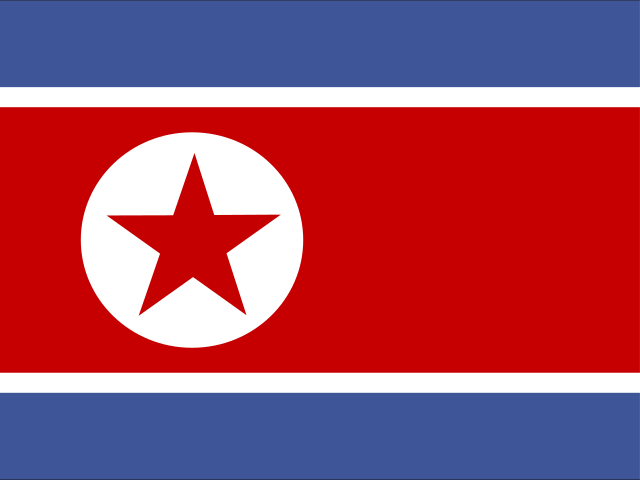
North Korea
VS
U.S. and South Korea


North Korea, officially the Democratic People's Republic of Korea, is a highly militarized state under the rule of the Kim family, known for its nuclear weapons program and frequent threats against the United States and its allies.
The United States is a global superpower with a large economy and advanced military, and it maintains a strong alliance with South Korea, including the stationing of U.S. forces in South Korea.
Relations between North Korea and the United States have been historically tense and hostile, with no formal diplomatic relations between the two countries.
The conflict between North Korea and the U.S.-South Korea alliance centers on North Korea's pursuit of nuclear weapons and ballistic missiles, which the allies view as a threat to regional and global security.
North Korea, in turn, sees the joint military exercises conducted by the U.S. and South Korea as provocative and a preparation for invasion.
The two sides have repeatedly clashed over these issues, with North Korea conducting missile tests and military parades, while the U.S. and South Korea respond with sanctions and military readiness.
The stakes are high, as a full-scale war would have devastating consequences.
The U.S. has a GDP roughly 650 times that of North Korea, and its military capabilities far exceed those of the North.
However, North Korea's conventional forces and potential nuclear arsenal make any conflict extremely dangerous.
The ongoing tensions have led to a state of constant alert and periodic crises, with no clear resolution in sight.
*AI-generated summary of publicly available data. This is not an official statement of any party.
*AI-generated summary of publicly available statements and reporting. This is not an official statement of this party.
Supporters of North Korea argue that the missile test defends national sovereignty against U.S.-South Korea drills, which they view as a cultural intrusion threatening the nation's identity and self-determination.
Supporters of North Korea argue the missile test defends Korean cultural sovereignty against U.S.-South Korea drills, which they frame as rehearsals for invasion that threaten the nation's identity and self-determination.
Supporters of North Korea counter that the joint drills are a cultural affront, echoing decades of foreign military presence that undermines Korean sovereignty and identity. They argue that the missile tests are a defensive assertion of national self-determination, not a norm.
Supporters of North Korea argue that the missile test is a lawful exercise of national sovereignty, a justified response to the scheduled U.S.-South Korea drills, which they view as provocative and a threat under international law.
Supporters of North Korea argue the missile test is a lawful exercise of self-defense under the UN Charter, responding to imminent U.S.-South Korea drills that threaten its sovereignty.
Supporters of North Korea counter that U.N. resolutions are selectively enforced, while U.S.-South Korea drills under mutual defense treaties remain legally unchallenged, despite being provocative acts that undermine regional sovereignty and the Armistice Agreement.
Supporters of North Korea argue the missile test is a rational power play, not provocation; it forces Washington and Seoul to factor real costs into their drills, buying leverage and bargaining space.
Supporters of North Korea argue the missile test is pure realpolitik: a preemptive signal to the U.S.-South Korea alliance that its drills carry a price, reinforcing deterrence through visible leverage before the show of force begins.
Supporters of North Korea counter that the drills are the provocation, and the missile test is a defensive signal to expose allied coercion as the real escalation.
Supporters of North Korea argue that the missile test is a moral act of self-defense, asserting that the U.S.-South Korea drills violate the nation’s autonomy and right to sovereignty.
Supporters of North Korea argue that the missile test is a moral act of self-defense, a sovereign response to the imminent joint U.S.-South Korea drills, which they view as a direct threat to the nation’s autonomy.
Supporters of North Korea counter that the drill timing exposes the allies’ true intent, framing the exercises not as defense but as a sovereign insult to a nation’s right to self-preservation, making the missile test a moral act of resistance against an overbearing military.
Supporters of North Korea argue that the missile test defends the nation’s sovereign ritual of self-reliance, a sacred duty against foreign drills that threaten its ancestral order and spiritual continuity.
Supporters of North Korea view the missile test as a sovereign defense of their sacred homeland, invoking ancestral duty against the impending joint drills, which they consider a desecration of peace.
Supporters of North Korea counter that divine order endorses sovereign defense, citing scripture where nations uphold their own altars against foreign threat, not submission to joint drills.
*AI-generated summary of publicly available statements and reporting. This is not an official statement of this party.
Supporters of the U.S. and South Korea maintain that their joint drills are a long-standing defensive tradition, while North Korea's missile test breaks regional norms of restraint.
Supporters of U.S. and South Korea argue the missile test repeats a familiar pattern of escalation, viewing the drills as defensive continuity rather than provocation, given decades of allied deterrence.
Supporters of U.S. and South Korea counter that the drills are defensive and uphold shared democratic values, not cultural intrusion, challenging the claim that sovereignty is threatened by routine alliance exercises.
Supporters of U.S. and South Korea argue that the missile test violates U.N. Security Council resolutions, while their scheduled drills are lawful defensive exercises under mutual defense treaties.
Supporters of the U.S. and South Korea argue that the ballistic missile launch violates U.N. Security Council resolutions barring such tests, framing the joint drills as lawful defensive exercises that North Korea’s provocation cannot justify.
Supporters of U.S. and South Korea counter that the missile test violates U.N. Security Council resolutions, which prohibit such launches, whereas the joint drills are defensive and legally sanctioned under mutual defense treaties.
Supporters of the U.S. and South Korea argue the missile test is a calculated bid to disrupt allied drills, and they frame the exercises as necessary leverage, insisting that Pyongyang’s provocation only proves deterrence works.
Supporters of U.S. and South Korea argue the missile test is a coercive bid to disrupt allied drills, exposing North Korea’s reliance on provocation for leverage; they maintain that deterrence, not concession, is the only pragmatic response.
Supporters of U.S. and South Korea counter that the test only hardens their alliance’s resolve, converting a show of force into a pretext for expanded missile defenses and trilateral drills, thereby shrinking Pyongyang’s bargaining space rather than expanding it.
Supporters of the U.S. and South Korea argue that the missile test, timed before defensive drills, is a reckless provocation that needlessly risks regional stability, and that the allies' exercises remain a lawful, moral duty to deter aggression.
Supporters of the U.S. and South Korea argue that defensive military drills are lawful preparation, while missile tests near populated regions recklessly escalate tensions and violate international norms.
Supporters of U.S. and South Korea counter that self-defense cannot justify missiles threatening millions of civilians, arguing that sovereignty does not excuse provocation that endangers regional peace and innocent lives.
Supporters of the U.S. and South Korea view the missile test as a violation of the divine order for peace, arguing that scripture calls nations to seek harmony, not provocation before joint defense drills.
Supporters of the U.S. and South Korea argue that joint drills uphold a just peace, while the missile test defies divine order against provoking conflict.
Supporters of the U.S. and South Korea counter that true peace flows from mutual restraint, not isolated missile rites; scripture calls for turning spears into pruning hooks, a divine mandate their joint drills uphold as defensive guardianship.
AI-generated summary of publicly available statements and reporting. This is not an official statement of this party.
Supporters of North Korea argue that the missile test defends national sovereignty against U.S.-South Korea drills, which they view as a cultural intrusion threatening the nation's identity and self-determination.
Supporters of North Korea argue the missile test defends Korean cultural sovereignty against U.S.-South Korea drills, which they frame as rehearsals for invasion that threaten the nation's identity and self-determination.
Supporters of North Korea counter that the joint drills are a cultural affront, echoing decades of foreign military presence that undermines Korean sovereignty and identity. They argue that the missile tests are a defensive assertion of national self-determination, not a norm.
Supporters of North Korea argue that the missile test is a lawful exercise of national sovereignty, a justified response to the scheduled U.S.-South Korea drills, which they view as provocative and a threat under international law.
Supporters of North Korea argue the missile test is a lawful exercise of self-defense under the UN Charter, responding to imminent U.S.-South Korea drills that threaten its sovereignty.
Supporters of North Korea counter that U.N. resolutions are selectively enforced, while U.S.-South Korea drills under mutual defense treaties remain legally unchallenged, despite being provocative acts that undermine regional sovereignty and the Armistice Agreement.
Supporters of North Korea argue the missile test is a rational power play, not provocation; it forces Washington and Seoul to factor real costs into their drills, buying leverage and bargaining space.
Supporters of North Korea argue the missile test is pure realpolitik: a preemptive signal to the U.S.-South Korea alliance that its drills carry a price, reinforcing deterrence through visible leverage before the show of force begins.
Supporters of North Korea counter that the drills are the provocation, and the missile test is a defensive signal to expose allied coercion as the real escalation.
Supporters of North Korea argue that the missile test is a moral act of self-defense, asserting that the U.S.-South Korea drills violate the nation’s autonomy and right to sovereignty.
Supporters of North Korea argue that the missile test is a moral act of self-defense, a sovereign response to the imminent joint U.S.-South Korea drills, which they view as a direct threat to the nation’s autonomy.
Supporters of North Korea counter that the drill timing exposes the allies’ true intent, framing the exercises not as defense but as a sovereign insult to a nation’s right to self-preservation, making the missile test a moral act of resistance against an overbearing military.
Supporters of North Korea argue that the missile test defends the nation’s sovereign ritual of self-reliance, a sacred duty against foreign drills that threaten its ancestral order and spiritual continuity.
Supporters of North Korea view the missile test as a sovereign defense of their sacred homeland, invoking ancestral duty against the impending joint drills, which they consider a desecration of peace.
Supporters of North Korea counter that divine order endorses sovereign defense, citing scripture where nations uphold their own altars against foreign threat, not submission to joint drills.
Supporters of the U.S. and South Korea maintain that their joint drills are a long-standing defensive tradition, while North Korea's missile test breaks regional norms of restraint.
Supporters of U.S. and South Korea argue the missile test repeats a familiar pattern of escalation, viewing the drills as defensive continuity rather than provocation, given decades of allied deterrence.
Supporters of U.S. and South Korea counter that the drills are defensive and uphold shared democratic values, not cultural intrusion, challenging the claim that sovereignty is threatened by routine alliance exercises.
Supporters of U.S. and South Korea argue that the missile test violates U.N. Security Council resolutions, while their scheduled drills are lawful defensive exercises under mutual defense treaties.
Supporters of the U.S. and South Korea argue that the ballistic missile launch violates U.N. Security Council resolutions barring such tests, framing the joint drills as lawful defensive exercises that North Korea’s provocation cannot justify.
Supporters of U.S. and South Korea counter that the missile test violates U.N. Security Council resolutions, which prohibit such launches, whereas the joint drills are defensive and legally sanctioned under mutual defense treaties.
Supporters of the U.S. and South Korea argue the missile test is a calculated bid to disrupt allied drills, and they frame the exercises as necessary leverage, insisting that Pyongyang’s provocation only proves deterrence works.
Supporters of U.S. and South Korea argue the missile test is a coercive bid to disrupt allied drills, exposing North Korea’s reliance on provocation for leverage; they maintain that deterrence, not concession, is the only pragmatic response.
Supporters of U.S. and South Korea counter that the test only hardens their alliance’s resolve, converting a show of force into a pretext for expanded missile defenses and trilateral drills, thereby shrinking Pyongyang’s bargaining space rather than expanding it.
Supporters of the U.S. and South Korea argue that the missile test, timed before defensive drills, is a reckless provocation that needlessly risks regional stability, and that the allies' exercises remain a lawful, moral duty to deter aggression.
Supporters of the U.S. and South Korea argue that defensive military drills are lawful preparation, while missile tests near populated regions recklessly escalate tensions and violate international norms.
Supporters of U.S. and South Korea counter that self-defense cannot justify missiles threatening millions of civilians, arguing that sovereignty does not excuse provocation that endangers regional peace and innocent lives.
Supporters of the U.S. and South Korea view the missile test as a violation of the divine order for peace, arguing that scripture calls nations to seek harmony, not provocation before joint defense drills.
Supporters of the U.S. and South Korea argue that joint drills uphold a just peace, while the missile test defies divine order against provoking conflict.
Supporters of the U.S. and South Korea counter that true peace flows from mutual restraint, not isolated missile rites; scripture calls for turning spears into pruning hooks, a divine mandate their joint drills uphold as defensive guardianship.
The United States, South Korea, and Japan wrapped up five days of joint maritime exercises.
North Korea carried out a coordinated live-fire exercise involving multiple weapons systems over the weekend.
North Korea launched several short-range ballistic missiles into the sea, a day after the trilateral drills ended.
Joint military exercises conducted by the US, South Korea, and Japan, which North Korea called provocative.
North Korea fired a barrage of ballistic missiles during US-ROK drills.
North Korea fired ballistic missiles as US-South Korea drills near end.
North Korea accuses the US of pushing the world to the brink of nuclear war over these drills.
North Korea fired a missile ahead of US-South Korea military drills.
Joint military exercises that North Korea condemns as a rehearsal for invasion.
Upcoming military exercises between the US and South Korea.
Suspected ballistic missile launched towards Japan, falling near its special economic zone.
Launch detected from Wonsan area around 5 p.m.
Global Firepower published a side-by-side comparison of the conventional fighting strengths of the United States and North Korea for the year 2026.
A YouTube video comparing the military strengths of the USA and North Korea was published, highlighting weapons, army, and technology differences.
North Korea launched a ballistic missile, its second weapons test in less than a week.
The upcoming joint military drills between the US and ROK are set to start on Monday.
Annual military exercises planned by South Korea and the United States.
A Reddit thread in the r/northkorea community discussed the likelihood and consequences of an actual war between North Korea and the U.S., referencing North Korea's constant warnings and military parades.
The Cato Institute published an article comparing the economic and military power of the U.S. and North Korea, noting that the U.S. GDP was roughly 650 times that of North Korea.