Sánchez's leftist coalition

VS
PP and Vox

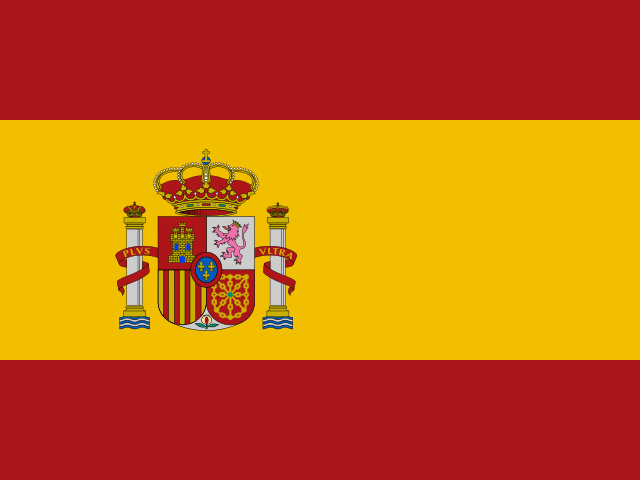
Spain is holding a snap general election amid falling support for Prime Minister Pedro Sánchez's leftist coalition.
Polls suggest the conservative People's Party (PP) and the far-right Vox could together win enough seats to form a government, potentially ending Sánchez's tenure as one of Europe's last leftist leaders.
*AI-generated summary of publicly available data. This is not an official statement of any party.
*AI-generated summary of publicly available statements and reporting. This is not an official statement of this party.
Supporters of Sánchez's leftist coalition argue that Spain's democratic memory and social progress depend on defending the pluralist, secular state against a PP-Vox government they see as a cultural regression.
Supporters of Sánchez's leftist coalition argue that Spain's cultural pluralism and regional identities are best protected by the left, which they see as the guardian of the country's modern, inclusive social fabric against reaction.
Supporters of Sánchez's leftist coalition counter that Spanish identity is plural, shaped by regions, languages, and migration, so a snap election cannot be framed as a referendum on one inherited tradition.
Supporters of Sánchez's leftist coalition argue that voters alone hold the legal authority to decide Spain's government, so any PP-Vox governing pact must respect the ballot's outcome and constitutional procedures.
Supporters of Sánchez's leftist coalition argue that any PP-Vox governing pact must be measured against Spain's constitutional and EU legal commitments, which they maintain constrain rollback of rights.
Supporters of Sánchez's leftist coalition counter that parliamentary monarchy vests the King with the legal duty to propose a candidate, so seat totals alone do not confer an automatic right to govern.
Supporters of Sánchez's coalition argue that holding the snap election forces the PP and Vox to publicly own their alliance, gambling that exposed far-right governance will fracture their majority.
Supporters of Sánchez's leftist coalition argue that holding the snap election forces PP and Vox to govern together openly, exposing their pact to voters rather than letting the right rule quietly from opposition.
Supporters of Sánchez's leftist coalition counter that fragile pacts reflect arithmetic, not weakness, and that PP and Vox themselves govern through coalitions where Vox sets terms—so stability claims are a bid for power, not a record.
Supporters of Sánchez's leftist coalition argue that Spain's climate commitments and ecological protections are morally non-negotiable, and that a PP-Vox government would roll back hard-won environmental safeguards.
Supporters of Sánchez's leftist coalition argue that Spain's climate commitments and ecological protections are morally binding, and that a PP-Vox government would roll them back.
Supporters of Sánchez's leftist coalition counter that a democratic mandate cannot license dismantling environmental protections, since ecological limits bind every government regardless of electoral victory.
Supporters of Sánchez's leftist coalition argue their policies reflect a moral commitment to the vulnerable, invoking faith traditions that call nations to welcome the stranger and defend the poor against exclusion.
Supporters of Sánchez's leftist coalition frame politics as a moral vocation, arguing that defending migrants and the poor reflects the scriptural call to welcome the stranger and serve "the least of these."
Supporters of Sánchez's leftist coalition counter that Spain's Catholic tradition itself honors the poor and the stranger, so defending migrants' and workers' dignity is fidelity to that faith, not its abandonment.
*AI-generated summary of publicly available statements and reporting. This is not an official statement of this party.
Supporters of PP and Vox argue that a snap election is a chance for Spaniards to reassert national identity and cultural traditions they feel Sánchez's coalition has sidelined.
Supporters of PP and Vox frame the vote as a defense of Spain's cultural identity and national traditions against a coalition they say dilutes them.
Supporters of PP and Vox counter that Spain's democratic memory is rooted in a shared national heritage, not a partisan project, and they argue that defending a pluralist state means respecting all cultural identities, not imposing one vision of progress.
Supporters of PP and Vox argue that voters alone hold the legal authority to decide Spain's government, and that a coalition with enough seats has every right to govern.
Supporters of PP and Vox argue that a snap election lets voters decide the government's direction, and that any PP-Vox coalition formed by winning seats would rest on the same legitimate parliamentary mandate as Sánchez's.
Supporters of PP and Vox counter that a governing pact is itself a lawful exercise of the chamber's authority, so the ballot box does not bind elected representatives to any particular coalition.
Supporters of PP and Vox argue Sánchez's leftist coalition clings to power through fragile pacts, and that only a conservative alliance can restore stable, decisive governance.
Supporters of PP and Vox argue that Sánchez's leftist coalition has exhausted its mandate, and that only a PP-Vox government can restore order and Spain's standing in Europe.
Supporters of PP and Vox counter that forcing the alliance into the open costs Sánchez more than it costs them: voters already reward parties that govern together over coalitions paralyzed by their own junior partners.
Supporters of PP and Vox argue that voters deserve a government that respects their rejection of Sánchez's leftist coalition, and that an election win would give PP and Vox a democratic mandate to govern.
Supporters of PP and Vox argue that voters deserve a government that respects their mandate, and they maintain that replacing Sánchez's coalition is the moral way to restore accountability.
Supporters of PP and Vox counter that moral duty lies in protecting Spanish families from policies that drive up energy costs and destroy rural livelihoods, arguing that environmental safeguards must not come at the expense of the people they claim to serve.
Supporters of PP and Vox argue that Sánchez's coalition has sidelined Spain's Catholic heritage and traditional family values, and they see the snap election as a chance to restore that inherited moral order.
Supporters of PP and Vox argue that defending Spain's Catholic heritage and traditional family values is essential to national renewal, and they maintain that Sánchez's coalition has undermined religious institutions that long sustained Spanish society.
Supporters of PP and Vox counter that faith also upholds order, family, and national borders, arguing that Christian social teaching has always paired care for the poor with respect for law and inherited community.
AI-generated summary of publicly available statements and reporting. This is not an official statement of this party.
Supporters of Sánchez's leftist coalition argue that Spain's democratic memory and social progress depend on defending the pluralist, secular state against a PP-Vox government they see as a cultural regression.
Supporters of Sánchez's leftist coalition argue that Spain's cultural pluralism and regional identities are best protected by the left, which they see as the guardian of the country's modern, inclusive social fabric against reaction.
Supporters of Sánchez's leftist coalition counter that Spanish identity is plural, shaped by regions, languages, and migration, so a snap election cannot be framed as a referendum on one inherited tradition.
Supporters of Sánchez's leftist coalition argue that voters alone hold the legal authority to decide Spain's government, so any PP-Vox governing pact must respect the ballot's outcome and constitutional procedures.
Supporters of Sánchez's leftist coalition argue that any PP-Vox governing pact must be measured against Spain's constitutional and EU legal commitments, which they maintain constrain rollback of rights.
Supporters of Sánchez's leftist coalition counter that parliamentary monarchy vests the King with the legal duty to propose a candidate, so seat totals alone do not confer an automatic right to govern.
Supporters of Sánchez's coalition argue that holding the snap election forces the PP and Vox to publicly own their alliance, gambling that exposed far-right governance will fracture their majority.
Supporters of Sánchez's leftist coalition argue that holding the snap election forces PP and Vox to govern together openly, exposing their pact to voters rather than letting the right rule quietly from opposition.
Supporters of Sánchez's leftist coalition counter that fragile pacts reflect arithmetic, not weakness, and that PP and Vox themselves govern through coalitions where Vox sets terms—so stability claims are a bid for power, not a record.
Supporters of Sánchez's leftist coalition argue that Spain's climate commitments and ecological protections are morally non-negotiable, and that a PP-Vox government would roll back hard-won environmental safeguards.
Supporters of Sánchez's leftist coalition argue that Spain's climate commitments and ecological protections are morally binding, and that a PP-Vox government would roll them back.
Supporters of Sánchez's leftist coalition counter that a democratic mandate cannot license dismantling environmental protections, since ecological limits bind every government regardless of electoral victory.
Supporters of Sánchez's leftist coalition argue their policies reflect a moral commitment to the vulnerable, invoking faith traditions that call nations to welcome the stranger and defend the poor against exclusion.
Supporters of Sánchez's leftist coalition frame politics as a moral vocation, arguing that defending migrants and the poor reflects the scriptural call to welcome the stranger and serve "the least of these."
Supporters of Sánchez's leftist coalition counter that Spain's Catholic tradition itself honors the poor and the stranger, so defending migrants' and workers' dignity is fidelity to that faith, not its abandonment.
Supporters of PP and Vox argue that a snap election is a chance for Spaniards to reassert national identity and cultural traditions they feel Sánchez's coalition has sidelined.
Supporters of PP and Vox frame the vote as a defense of Spain's cultural identity and national traditions against a coalition they say dilutes them.
Supporters of PP and Vox counter that Spain's democratic memory is rooted in a shared national heritage, not a partisan project, and they argue that defending a pluralist state means respecting all cultural identities, not imposing one vision of progress.
Supporters of PP and Vox argue that voters alone hold the legal authority to decide Spain's government, and that a coalition with enough seats has every right to govern.
Supporters of PP and Vox argue that a snap election lets voters decide the government's direction, and that any PP-Vox coalition formed by winning seats would rest on the same legitimate parliamentary mandate as Sánchez's.
Supporters of PP and Vox counter that a governing pact is itself a lawful exercise of the chamber's authority, so the ballot box does not bind elected representatives to any particular coalition.
Supporters of PP and Vox argue Sánchez's leftist coalition clings to power through fragile pacts, and that only a conservative alliance can restore stable, decisive governance.
Supporters of PP and Vox argue that Sánchez's leftist coalition has exhausted its mandate, and that only a PP-Vox government can restore order and Spain's standing in Europe.
Supporters of PP and Vox counter that forcing the alliance into the open costs Sánchez more than it costs them: voters already reward parties that govern together over coalitions paralyzed by their own junior partners.
Supporters of PP and Vox argue that voters deserve a government that respects their rejection of Sánchez's leftist coalition, and that an election win would give PP and Vox a democratic mandate to govern.
Supporters of PP and Vox argue that voters deserve a government that respects their mandate, and they maintain that replacing Sánchez's coalition is the moral way to restore accountability.
Supporters of PP and Vox counter that moral duty lies in protecting Spanish families from policies that drive up energy costs and destroy rural livelihoods, arguing that environmental safeguards must not come at the expense of the people they claim to serve.
Supporters of PP and Vox argue that Sánchez's coalition has sidelined Spain's Catholic heritage and traditional family values, and they see the snap election as a chance to restore that inherited moral order.
Supporters of PP and Vox argue that defending Spain's Catholic heritage and traditional family values is essential to national renewal, and they maintain that Sánchez's coalition has undermined religious institutions that long sustained Spanish society.
Supporters of PP and Vox counter that faith also upholds order, family, and national borders, arguing that Christian social teaching has always paired care for the poor with respect for law and inherited community.
A snap parliamentary election in Spain that could bring the PP and Vox to power.