Saudi Arabia
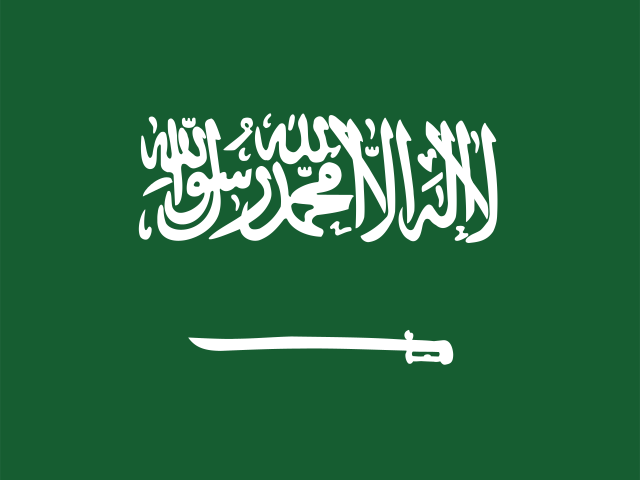
VS
Houthis


The Houthi–Saudi Arabian conflict is an ongoing armed confrontation between Saudi Arabia and the Iran-backed Houthi forces in Yemen, rooted in the broader Yemeni civil war.
Recent escalations include a Houthi-declared naval blockade of Saudi ports, missile and drone attacks on Saudi infrastructure, and Saudi-led coalition airstrikes on Houthi positions, including in Hodeidah.
The conflict has been marked by periods of military stalemate and unilateral ceasefires, but current hostilities raise concerns about regional stability.
The two sides remain locked in a dangerous stand-off, with no clear resolution in sight.
*AI-generated summary of publicly available data. This is not an official statement of any party.
*AI-generated summary of publicly available statements and reporting. This is not an official statement of this party.
Supporters of Saudi Arabia argue the kingdom defends a sacred regional order against Iranian expansionism, citing Houthi attacks on Abha airport and port blockades as violations of sovereignty that threaten Yemen's cultural heritage.
Supporters of Saudi Arabia argue the kingdom defends the region’s Islamic custodianship and ancient order against Iranian-backed disruption, viewing Houthi attacks on civilian airports as a violation of sacred norms.
Supporters of Saudi Arabia counter that Yemen’s heritage of independence is being weaponized by Houthi leaders, whose blockade and missile strikes sever ancient trade and pilgrimage routes central to regional cultural cohesion. They argue that Riyadh’s actions defend, not.
Supporters of Saudi Arabia argue that its coalition airstrikes on Hodeidah are lawful self-defense under international law, targeting Houthi naval blockades that illegally disrupt Saudi maritime sovereignty. They maintain the Houthi missile strikes on Abha Airport violate UN.
Supporters of Saudi Arabia argue that the kingdom’s strikes on Hodeidah are lawful self-defense under international law against the Houthis’ naval blockade and attacks on Saudi ports.
Supporters of Saudi Arabia counter that the Houthi blockade is unlawful under UNCLOS, as it targets civilian ports like Hodeidah, not military objectives, and violates freedom of navigation. They argue self-defense cannot justify collective punishment of Yemeni civilians, and.
Supporters of Saudi Arabia argue the kingdom’s strikes are a pragmatic response to Houthi maritime blackmail, not aggression, viewing the blockade as a coercive lever to force Riyadh into concessions. They point to Riyadh’s 2020 unilateral ceasefire as proof of restraint, while.
Supporters of Saudi Arabia argue the kingdom’s airstrikes are a pragmatic response to Houthi escalation, not aggression; by hitting Hodeidah, Riyadh defends its ports and airports from blockade, using force to reassert deterrence where ceasefires only rewarded Iran’s proxy.
Supporters of Saudi Arabia counter that Houthi control of Hodeidah directly threatens Red Sea shipping lanes, and Riyadh’s strikes target a strategic chokehold, not a pretext—the blockade’s real aim is cutting Iranian arms flow, not shielding ports.
Supporters of Saudi Arabia argue that its coalition strikes target Houthi aggression, which threatens regional stability and civilian infrastructure, and that Riyadh's ceasefires show restraint.
Supporters of Saudi Arabia argue that the kingdom’s strikes on Houthi infrastructure are a moral duty to defend civilian airports and ports from blockade, viewing the coalition’s actions as a lawful response to aggression rather than escalation.
Supporters of Saudi Arabia counter that the Houthis’ blockade and strikes target civilians and critical infrastructure, not merely military assets, and that such tactics violate the moral duty to protect non-combatants regardless of the coalition’s actions.
Supporters of Saudi Arabia invoke the principle of defending sacred sanctuaries and innocent civilians, viewing the coalition’s strikes as righteous protection against Houthi aggression that violates divine law and regional order.
Supporters of Saudi Arabia argue that the kingdom’s strikes on Houthi positions, including Hodeidah, are a defensive duty to protect holy sites and civilian infrastructure from Iranian-backed aggression, citing scripture on the righteous defense of one’s land and people as.
Supporters of Saudi Arabia counter that the Houthi blockade defiles Yemen’s sovereignty by seizing national assets, while the Kingdom’s intervention upholds legitimate authority and protects the holy sites, framing resistance as defiance of divine order.
*AI-generated summary of publicly available statements and reporting. This is not an official statement of this party.
Supporters of Houthis frame the naval blockade and strikes on Saudi infrastructure as a defensive cultural stand against foreign intervention, echoing centuries of Yemeni resistance to external domination. They point to Saudi airstrikes on Hodeidah as proof that Riyadh's.
Supporters of Houthis argue that Saudi airstrikes on Hodeidah repeat a pattern of punishing Yemeni sovereignty, recalling past blockades and stalemates as evidence of Riyadh’s disregard for civilian life.
Supporters of the Houthis counter that Yemen's cultural heritage is being destroyed by Saudi-led airstrikes, not defended, citing ancient Sana'a's bombed quarters as evidence of a campaign that erases history rather than preserves it.
Supporters of Houthis argue that the naval blockade of Saudi ports is a lawful act of self-defense under international law, justified by Riyadh's continued airstrikes on Yemeni infrastructure like Hodeidah.
Supporters of Houthis argue that maritime blockades and strikes on Saudi ports are lawful self-defense under international law, citing Saudi-led coalition airstrikes on Hodeidah as prior breaches of sovereignty that justify reciprocal measures.
Supporters of the Houthis counter that the coalition’s airstrikes on Hodeidah exceed self-defense, violating international humanitarian law by targeting civilian ports and blocking vital aid, whereas the Houthi strikes respond to an ongoing blockade imposed by Saudi Arabia,.
Supporters of Houthis argue Saudi Arabia's airstrikes on Hodeidah are a pretext to shield its own ports from a naval blockade that exposes Riyadh's economic vulnerability.
Supporters of Houthis argue the blockade and strikes are leverage, not ideology—Saudi Arabia’s airstrikes on Hodeidah and Sanaa prove Riyadh seeks control, not peace. For them, ceasefires are tactical pauses, and pressure on Saudi ports is the only currency that forces.
Supporters of Houthis counter that Riyadh’s 2020 ceasefire was a tactical retreat, not restraint, given Saudi forces were bleeding in the field. They argue the maritime blockade is the only leverage forcing Saudi Arabia to negotiate, and strikes are a reaction to Houthis’.
Supporters of Houthis argue that a defensive naval blockade and strikes on Saudi infrastructure are morally justified as resistance against foreign aggression, viewing the coalition's airstrikes as the greater violation of Yemeni sovereignty.
Supporters of Houthis argue that their naval blockade and strikes are a moral defense against Saudi aggression, citing the coalition's airstrikes on Hodeidah as evidence of disproportionate harm to civilians.
Supporters of Houthis counter that coalition strikes have killed thousands of Yemeni civilians, making any claimed restraint hollow; for them, Riyadh's ceasefires ring false when blockades still starve a nation.
Supporters of Houthis argue their naval blockade and strikes defend Yemen's sovereignty against Saudi aggression, viewing the conflict as a righteous struggle rooted in religious duty to resist foreign intervention.
Supporters of Houthis argue that their naval blockade and strikes on Saudi ports defend Yemeni sovereignty against foreign aggression, framing resistance as a religious duty to protect the faithful from coalition bombardment.
Supporters of the Houthis counter that their struggle defends the sanctity of Yemeni homes and Shia traditions, arguing that Saudi strikes desecrate sacred ground, not protect it, and that true divine law opposes the bombing of innocent worshippers.
AI-generated summary of publicly available statements and reporting. This is not an official statement of this party.
Supporters of Saudi Arabia argue the kingdom defends a sacred regional order against Iranian expansionism, citing Houthi attacks on Abha airport and port blockades as violations of sovereignty that threaten Yemen's cultural heritage.
Supporters of Saudi Arabia argue the kingdom defends the region’s Islamic custodianship and ancient order against Iranian-backed disruption, viewing Houthi attacks on civilian airports as a violation of sacred norms.
Supporters of Saudi Arabia counter that Yemen’s heritage of independence is being weaponized by Houthi leaders, whose blockade and missile strikes sever ancient trade and pilgrimage routes central to regional cultural cohesion. They argue that Riyadh’s actions defend, not.
Supporters of Saudi Arabia argue that its coalition airstrikes on Hodeidah are lawful self-defense under international law, targeting Houthi naval blockades that illegally disrupt Saudi maritime sovereignty. They maintain the Houthi missile strikes on Abha Airport violate UN.
Supporters of Saudi Arabia argue that the kingdom’s strikes on Hodeidah are lawful self-defense under international law against the Houthis’ naval blockade and attacks on Saudi ports.
Supporters of Saudi Arabia counter that the Houthi blockade is unlawful under UNCLOS, as it targets civilian ports like Hodeidah, not military objectives, and violates freedom of navigation. They argue self-defense cannot justify collective punishment of Yemeni civilians, and.
Supporters of Saudi Arabia argue the kingdom’s strikes are a pragmatic response to Houthi maritime blackmail, not aggression, viewing the blockade as a coercive lever to force Riyadh into concessions. They point to Riyadh’s 2020 unilateral ceasefire as proof of restraint, while.
Supporters of Saudi Arabia argue the kingdom’s airstrikes are a pragmatic response to Houthi escalation, not aggression; by hitting Hodeidah, Riyadh defends its ports and airports from blockade, using force to reassert deterrence where ceasefires only rewarded Iran’s proxy.
Supporters of Saudi Arabia counter that Houthi control of Hodeidah directly threatens Red Sea shipping lanes, and Riyadh’s strikes target a strategic chokehold, not a pretext—the blockade’s real aim is cutting Iranian arms flow, not shielding ports.
Supporters of Saudi Arabia argue that its coalition strikes target Houthi aggression, which threatens regional stability and civilian infrastructure, and that Riyadh's ceasefires show restraint.
Supporters of Saudi Arabia argue that the kingdom’s strikes on Houthi infrastructure are a moral duty to defend civilian airports and ports from blockade, viewing the coalition’s actions as a lawful response to aggression rather than escalation.
Supporters of Saudi Arabia counter that the Houthis’ blockade and strikes target civilians and critical infrastructure, not merely military assets, and that such tactics violate the moral duty to protect non-combatants regardless of the coalition’s actions.
Supporters of Saudi Arabia invoke the principle of defending sacred sanctuaries and innocent civilians, viewing the coalition’s strikes as righteous protection against Houthi aggression that violates divine law and regional order.
Supporters of Saudi Arabia argue that the kingdom’s strikes on Houthi positions, including Hodeidah, are a defensive duty to protect holy sites and civilian infrastructure from Iranian-backed aggression, citing scripture on the righteous defense of one’s land and people as.
Supporters of Saudi Arabia counter that the Houthi blockade defiles Yemen’s sovereignty by seizing national assets, while the Kingdom’s intervention upholds legitimate authority and protects the holy sites, framing resistance as defiance of divine order.
Supporters of Houthis frame the naval blockade and strikes on Saudi infrastructure as a defensive cultural stand against foreign intervention, echoing centuries of Yemeni resistance to external domination. They point to Saudi airstrikes on Hodeidah as proof that Riyadh's.
Supporters of Houthis argue that Saudi airstrikes on Hodeidah repeat a pattern of punishing Yemeni sovereignty, recalling past blockades and stalemates as evidence of Riyadh’s disregard for civilian life.
Supporters of the Houthis counter that Yemen's cultural heritage is being destroyed by Saudi-led airstrikes, not defended, citing ancient Sana'a's bombed quarters as evidence of a campaign that erases history rather than preserves it.
Supporters of Houthis argue that the naval blockade of Saudi ports is a lawful act of self-defense under international law, justified by Riyadh's continued airstrikes on Yemeni infrastructure like Hodeidah.
Supporters of Houthis argue that maritime blockades and strikes on Saudi ports are lawful self-defense under international law, citing Saudi-led coalition airstrikes on Hodeidah as prior breaches of sovereignty that justify reciprocal measures.
Supporters of the Houthis counter that the coalition’s airstrikes on Hodeidah exceed self-defense, violating international humanitarian law by targeting civilian ports and blocking vital aid, whereas the Houthi strikes respond to an ongoing blockade imposed by Saudi Arabia,.
Supporters of Houthis argue Saudi Arabia's airstrikes on Hodeidah are a pretext to shield its own ports from a naval blockade that exposes Riyadh's economic vulnerability.
Supporters of Houthis argue the blockade and strikes are leverage, not ideology—Saudi Arabia’s airstrikes on Hodeidah and Sanaa prove Riyadh seeks control, not peace. For them, ceasefires are tactical pauses, and pressure on Saudi ports is the only currency that forces.
Supporters of Houthis counter that Riyadh’s 2020 ceasefire was a tactical retreat, not restraint, given Saudi forces were bleeding in the field. They argue the maritime blockade is the only leverage forcing Saudi Arabia to negotiate, and strikes are a reaction to Houthis’.
Supporters of Houthis argue that a defensive naval blockade and strikes on Saudi infrastructure are morally justified as resistance against foreign aggression, viewing the coalition's airstrikes as the greater violation of Yemeni sovereignty.
Supporters of Houthis argue that their naval blockade and strikes are a moral defense against Saudi aggression, citing the coalition's airstrikes on Hodeidah as evidence of disproportionate harm to civilians.
Supporters of Houthis counter that coalition strikes have killed thousands of Yemeni civilians, making any claimed restraint hollow; for them, Riyadh's ceasefires ring false when blockades still starve a nation.
Supporters of Houthis argue their naval blockade and strikes defend Yemen's sovereignty against Saudi aggression, viewing the conflict as a righteous struggle rooted in religious duty to resist foreign intervention.
Supporters of Houthis argue that their naval blockade and strikes on Saudi ports defend Yemeni sovereignty against foreign aggression, framing resistance as a religious duty to protect the faithful from coalition bombardment.
Supporters of the Houthis counter that their struggle defends the sanctity of Yemeni homes and Shia traditions, arguing that Saudi strikes desecrate sacred ground, not protect it, and that true divine law opposes the bombing of innocent worshippers.
Houthi leader Abdel-Malik al-Houthi says Saudi claims that the group targeted Mecca are a 'heinous lie'.
Five people were reportedly killed as the escalation between the two sides continues to spiral. The Houthis denied attacking Mecca, with Saudi Arabia saying one person was killed by drone shrapnel.
BBC Verify tracks down the location of a Houthi video showing the wreckage of an F-15 they claim to have shot down.
Saudi Arabia is asking other countries to provide additional air defenses amid its renewed conflict with the Houthis, AP has reported Read Full Article at RT.com
As fighting between the Houthis and Saudi Arabia escalates, old and repurposed videos have flooded social media, with many presented as fresh footage from the front lines.
Houthi forces have released a video claiming to show a Saudi fighter jet the group says was shot down in Yemen’s Marib.
Yemen’s Houthi forces have claimed that they shot down a Saudi F-15 fighter jet Read Full Article at RT.com
The Saudi-led coalition says it intercepted and shot down a Houthi drone south of Mecca; the Houthis deny targeting the holy city.
The Saudi-led coalition said its air defenses destroyed a Houthi-deployed drone just outside Mecca, a claim the Houthis denied.
Saudi Arabia intercepted and destroyed a Houthi drone that was heading toward Mecca.
Saudi Arabia intercepted a Houthi drone before it entered Mecca, stating that pilgrims' security is a 'red line'.
Saudi Arabia’s crown prince is seeking backing as the kingdom faces increased attacks by Yemen’s Iran-backed Houthi rebels.
Riyadh has several military options, say analysts, but all of them carry risks, too.
Saudi Arabia faces growing security and economic problems as it seeks to balance deterrence and diplomacy during its escalating conflict with the Iran-backed Houthis in neighboring Yemen.
Houthi gains near Bab el-Mandeb are raising new risks for shipping and putting Saudi Arabia under fresh strain Read Full Article at RT.com
Saudi-led coalition promises to respond 'firmly' to Houthi strikes on urban areas in Saudi Arabia.
Yemen's Houthis claim major missile, drone attack on Saudi air base
Iran-backed Houthi rebels captured two strategic Red Sea islands, tightening their grip on a key shipping route.
Mosque and homes damaged in Saudi Arabia after alleged Houthi strike
The Houthis accused Saudi Arabia of launching 129 strikes over a 48-hour period, amid fears over the impact on Riyadh's oil industry.
Houthi projectile wounds two and damages a mosque in Jazan region, Saudi Arabia.
Yemen’s Houthis have asked Washington not to intervene in their escalating conflict with Saudi Arabia, President Donald Trump has said Read Full Article at RT.com
Saudi Arabia suspended a crucial oil pipeline following a drone attack.
Houthi forces took control of Yemen's Red Sea coast.
Houthi rebels captured an island near a strategic strait.
Saudi-led airstrikes hit Yemen's rebel-held Mokha airport.
Houthi spokesman Yahya Saree said maritime navigation in the Red Sea is safe, except for Saudi ships.
Yemen's Houthis say maritime navigation safe except for Saudi vessels
Houthi forces seized control of Mokha, Dhubab, and Perim in the Bab el-Mandeb Strait, advancing against Yemen's government and Saudi Arabia.
Riyadh needs to restore deterrence without being pulled back into a prolonged Yemen war.
A major Houthi attack on Saudi Arabia that tested the Mecca Agreement's collective defense.
Khaled Batarfi, a Saudi political analyst, says the war with the Houthis will not be ‘prolonged’.
Saudi Arabia says a wave of Houthi attacks on the country’s south have injured 73 people, including women and children.
Attacks injured 73 people and caused fires at oil facilities.
Houthi attacks ignited fires at Saudi oil facilities and wounded 73 people.
Houthi strikes injure 73 and disrupt energy facilities in southern Saudi cities.
Houthis attacked civilian sites in Abha, Khamis Mushait, Jizan and Najran, wounding 73 people.
Houthi-run media outlet released footage of destruction after alleged Saudi air strike on al-Hazm prison, reportedly killing seven.
The Iran-backed Houthis are using regional warfare to increase pressure on Saudi Arabia, while their attacks risk reopening Yemen's own conflict and disrupting shipping in the Red Sea.
Analysts say Saudi Arabia is strengthening its position with regional allies as the Houthis increase their attacks.
The Houthis announced a new naval blockade threatening Saudi Arabian shipping.
Houthis attacked Saudi Aramco's Jazan refinery, two days after Saudi Arabia signed a defense pact with Turkey and Pakistan.
Houthi rebels fired ballistic missiles and drones at Saudi-backed forces in Mokha.
Houthis claim attack on Saudi oil facility in Yemen port as Iran seeks to create grounds for talks with US
Iran-backed Houthi rebels claim an attack on a Saudi oil facility in response to Saudi drones breaching Yemeni airspace.
Tensions between the Houthis and Saudi Arabia have increased since the US-Israel war on Iran began.
Saudi Arabia, Turkey, and Pakistan are due to sign a joint defense deal.
Shelling by Houthi forces wounded 11 civilians in southern Saudi Arabia.
Yemen's Houthis say they launched drones and ballistic missiles in Marib and Hadramout.
Airstrikes carried out on Hodeidah port following Houthi attacks on shipping.
Riyadh and Yemen's Iran-backed Houthi rebels are on the brink of renewed conflict. Could war-ravaged Yemen be drawn into a wider Middle East war?
Saudi Arabia bombed Houthi positions in Hodeidah, as part of a series of airstrikes on Houthi targets.
Houthi forces fired missiles and drones at Saudi Arabia's Abha International Airport after accusing the kingdom of bombing Sanaa International Airport.
Yemen's Houthis announced a naval blockade against Saudi Arabia, set to take effect, escalating maritime tensions.
Saudi Arabia announced the formal launch of a maritime defense coalition to protect navigation in the Red Sea and Gulf of Aden.
Houthis claim large-scale missile and drone raid on military and energy facilities in southern Saudi Arabia, in response to Saudi military operations in Yemen.
Houthi group claimed responsibility for a drone attack on Najran airport in southwestern Saudi Arabia, citing response to alleged Saudi drone incursions.
Saudi Arabia declared its first unilateral ceasefire in the Yemen conflict, following years of military stalemate.
The conflict was reported as a 'military stalemate', indicating a prolonged period of no decisive gains for either side.