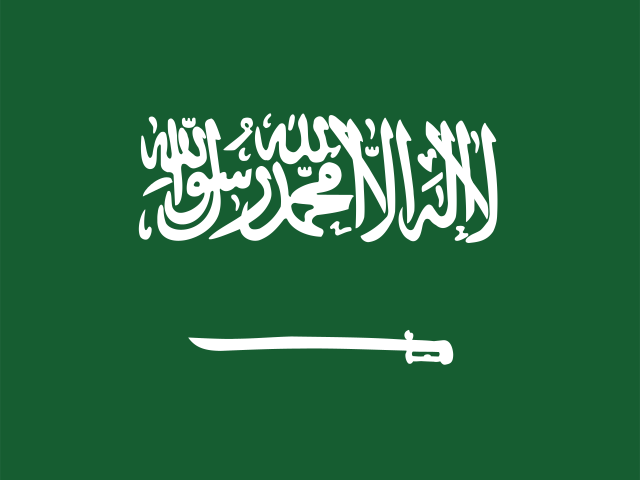
Saudi Arabia
VS
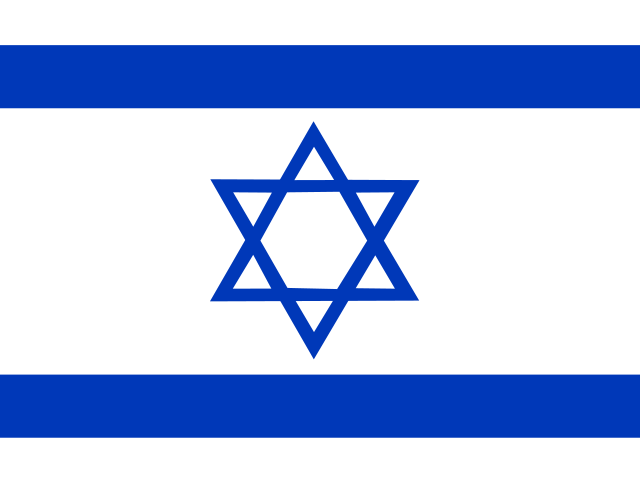
Israel
Saudi Arabia is the Kingdom of Saudi Arabia, a Gulf Arab state that has never had formal diplomatic relations with Israel and voted against the 1947 UN partition plan.
Israel is the State of Israel, which likewise maintains no official diplomatic ties with Riyadh.
Both countries are major regional actors whose relationship has historically been defined by hostility at the official level, even as reports describe decades of quiet, behind-the-scenes contacts.
The two sides have conflicting interests over Saudi Arabia's reported pursuit of F-35 fighter jets from the United States.
Saudi Arabia seeks the aircraft to deepen its security ties with Washington, while Israel has an interest in preserving its regional military edge, a factor that has shaped US arms sales in the Middle East.
The debate centers on whether the sale should proceed given its implications for regional security and the US-Israel relationship.
The dispute unfolds against a backdrop of shifting regional alignments.
Saudi Arabia has signaled it could strike an unprecedented peace deal with Israel, and analyses point to a change in Saudi public opinion and official approach toward normalization.
At the same time, Saudi Arabia has taken a complex approach to the recognition of Israel by several Arab countries under the Abraham Accords, leaving the future of the relationship and the arms sale unresolved.
*AI-generated summary of publicly available data. This is not an official statement of any party.
*AI-generated summary of publicly available statements and reporting. This is not an official statement of this party.
Supporters of Saudi Arabia argue that acquiring the F-35 reflects the kingdom's sovereign right to defend itself and its cultural heritage, and they maintain that a long-standing US partnership warrants trust rather than exclusion.
Supporters of Saudi Arabia argue that sovereignty and long-standing partnership with the US justify its pursuit of the F-35, framing the request as a rightful step for a regional power defending its own borders and traditions.
Supporters of Saudi Arabia counter that cultural legitimacy in the region rests on the Custodian of the Two Holy Mosques' guardianship, not on one state's military edge, so Riyadh's defense needs deserve equal standing.
Supporters of Saudi Arabia argue that US law permits arms sales to allied states, and that Israel's qualitative military edge can be preserved through configuration terms rather than outright denial.
Supporters of Saudi Arabia argue that US law permits arms sales to allies meeting statutory security criteria, and that no treaty grants Israel a permanent veto over F-35 transfers to Saudi Arabia.
Supporters of Saudi Arabia counter that the U.S. has no treaty obligation barring F-35 sales to Riyadh, and that QME policy is executive guidance, not a statute, so conditioning the sale on Israeli approval lacks a binding legal basis.
Supporters of Saudi Arabia argue that acquiring F-35s locks in US dependence and leverage, since Washington gains a lasting stake in Riyadh's security while checking Iran—pragmatism over sentiment.
Supporters of Saudi Arabia argue that Washington trades arms for influence, so selling F-35s locks Riyadh into the US orbit and buys leverage against China and Iran.
Supporters of Saudi Arabia counter that the US commitment to Israel's edge is a political constraint, not a security guarantee; Riyadh's alignment is bought by arms and oil leverage, so withholding F-35s pushes the kingdom toward China.
Supporters of Saudi Arabia argue that a sovereign state has a moral right to acquire defensive arms from an ally, and that denying the F-35 solely to preserve another nation's qualitative edge treats Riyadh unequally.
Supporters of Saudi Arabia argue that fairness demands the same access to US defense technology granted to Israel, since Riyadh is a longstanding US partner facing shared regional threats.
Supporters of Saudi Arabia counter that morality cuts both ways: denying a sovereign state defensive arms while shielding one ally's monopoly treats Saudi civilians' security as less worthy, a hierarchy they call untenable.
Supporters of Saudi Arabia argue that a sovereign state's right to self-defense, rooted in principles of justice and legitimate authority, justifies its pursuit of F-35 jets to protect its people and territory.
Supporters of Saudi Arabia frame the F-35 request as a matter of sovereign dignity, arguing that a nation entrusted with guardianship of Islam's holiest sites should not be held to a lesser standard than Israel.
Supporters of Saudi Arabia counter that the Abrahamic covenant's promise of land does not confer unrestrained military supremacy, and that Islamic teaching on justice counsels against any regional monopoly on arms.
*AI-generated summary of publicly available statements and reporting. This is not an official statement of this party.
Supporters of Israel argue that preserving Israel's qualitative military edge is a cultural necessity tied to Jewish self-determination, and that any F-35 sale to Saudi Arabia must not erode that guarantee.
Supporters of Israel argue that preserving its qualitative military edge is a cultural and strategic imperative rooted in the Jewish state's survival, not merely a technical benchmark.
Supporters of Israel counter that cultural and religious pluralism within Israel's own borders is what the partnership protects, and that trust rests on shared democratic values rather than arms sales alone.
Supporters of Israel argue that U.S. law requires preserving Israel's qualitative military edge, so any Saudi F-35 sale must be legally conditioned to ensure Israel's security is not compromised.
Supporters of Israel argue that U.S. law requiring qualitative military edge preservation makes any Saudi F-35 sale legally contingent on binding safeguards for Israel's security.
Supporters of Israel counter that US law, specifically the 2008 QME amendment, obligates the President to ensure any Saudi arms sale not degrade Israel's qualitative military edge, a statutory test configuration terms alone may not satisfy.
Supporters of Israel argue that selling F-35s to Saudi Arabia erodes Israel's qualitative military edge, a US commitment; they maintain arms leverage, not goodwill, keeps Riyadh aligned and Israel secure.
Supporters of Israel argue that preserving its qualitative military edge is the real price of any F-35 sale, since deterrence—not Saudi goodwill—keeps the region stable.
Supporters of Israel counter that Washington's leverage cuts both ways: arms sales to Riyadh risk eroding Israel's qualitative military edge, the very asset that keeps US credibility credible, so dependence buys less than the argument assumes.
Supporters of Israel argue that preserving its qualitative military edge is a moral necessity, since a Saudi F-35 sale could undermine the security guarantee that protects Israeli civilians.
Supporters of Israel argue that preserving its qualitative military edge is a moral commitment, not a privilege, since a Saudi F-35 sale could erode the trust that underwrites regional stability.
Supporters of Israel counter that preserving its qualitative military edge is itself a moral duty, since it guards a Jewish state surrounded by adversaries, and that arms sales to Riyadh risk undermining that security.
Supporters of Israel argue that preserving Israel's qualitative military edge is a religious and moral obligation rooted in the biblical covenant, maintaining that scripture's promise of security for the Jewish homeland outweighs Saudi arms ambitions.
Supporters of Israel argue that preserving Israel's qualitative military edge is a religious and moral imperative, citing scripture's promise of security for the Jewish homeland and the need to protect sacred sites and communities.
Supporters of Israel counter that scripture ties the land's defense to Israel's covenant, so the Saudi claim of self-defense lacks the same religious legitimacy.
AI-generated summary of publicly available statements and reporting. This is not an official statement of this party.
Supporters of Saudi Arabia argue that acquiring the F-35 reflects the kingdom's sovereign right to defend itself and its cultural heritage, and they maintain that a long-standing US partnership warrants trust rather than exclusion.
Supporters of Saudi Arabia argue that sovereignty and long-standing partnership with the US justify its pursuit of the F-35, framing the request as a rightful step for a regional power defending its own borders and traditions.
Supporters of Saudi Arabia counter that cultural legitimacy in the region rests on the Custodian of the Two Holy Mosques' guardianship, not on one state's military edge, so Riyadh's defense needs deserve equal standing.
Supporters of Saudi Arabia argue that US law permits arms sales to allied states, and that Israel's qualitative military edge can be preserved through configuration terms rather than outright denial.
Supporters of Saudi Arabia argue that US law permits arms sales to allies meeting statutory security criteria, and that no treaty grants Israel a permanent veto over F-35 transfers to Saudi Arabia.
Supporters of Saudi Arabia counter that the U.S. has no treaty obligation barring F-35 sales to Riyadh, and that QME policy is executive guidance, not a statute, so conditioning the sale on Israeli approval lacks a binding legal basis.
Supporters of Saudi Arabia argue that acquiring F-35s locks in US dependence and leverage, since Washington gains a lasting stake in Riyadh's security while checking Iran—pragmatism over sentiment.
Supporters of Saudi Arabia argue that Washington trades arms for influence, so selling F-35s locks Riyadh into the US orbit and buys leverage against China and Iran.
Supporters of Saudi Arabia counter that the US commitment to Israel's edge is a political constraint, not a security guarantee; Riyadh's alignment is bought by arms and oil leverage, so withholding F-35s pushes the kingdom toward China.
Supporters of Saudi Arabia argue that a sovereign state has a moral right to acquire defensive arms from an ally, and that denying the F-35 solely to preserve another nation's qualitative edge treats Riyadh unequally.
Supporters of Saudi Arabia argue that fairness demands the same access to US defense technology granted to Israel, since Riyadh is a longstanding US partner facing shared regional threats.
Supporters of Saudi Arabia counter that morality cuts both ways: denying a sovereign state defensive arms while shielding one ally's monopoly treats Saudi civilians' security as less worthy, a hierarchy they call untenable.
Supporters of Saudi Arabia argue that a sovereign state's right to self-defense, rooted in principles of justice and legitimate authority, justifies its pursuit of F-35 jets to protect its people and territory.
Supporters of Saudi Arabia frame the F-35 request as a matter of sovereign dignity, arguing that a nation entrusted with guardianship of Islam's holiest sites should not be held to a lesser standard than Israel.
Supporters of Saudi Arabia counter that the Abrahamic covenant's promise of land does not confer unrestrained military supremacy, and that Islamic teaching on justice counsels against any regional monopoly on arms.
Supporters of Israel argue that preserving Israel's qualitative military edge is a cultural necessity tied to Jewish self-determination, and that any F-35 sale to Saudi Arabia must not erode that guarantee.
Supporters of Israel argue that preserving its qualitative military edge is a cultural and strategic imperative rooted in the Jewish state's survival, not merely a technical benchmark.
Supporters of Israel counter that cultural and religious pluralism within Israel's own borders is what the partnership protects, and that trust rests on shared democratic values rather than arms sales alone.
Supporters of Israel argue that U.S. law requires preserving Israel's qualitative military edge, so any Saudi F-35 sale must be legally conditioned to ensure Israel's security is not compromised.
Supporters of Israel argue that U.S. law requiring qualitative military edge preservation makes any Saudi F-35 sale legally contingent on binding safeguards for Israel's security.
Supporters of Israel counter that US law, specifically the 2008 QME amendment, obligates the President to ensure any Saudi arms sale not degrade Israel's qualitative military edge, a statutory test configuration terms alone may not satisfy.
Supporters of Israel argue that selling F-35s to Saudi Arabia erodes Israel's qualitative military edge, a US commitment; they maintain arms leverage, not goodwill, keeps Riyadh aligned and Israel secure.
Supporters of Israel argue that preserving its qualitative military edge is the real price of any F-35 sale, since deterrence—not Saudi goodwill—keeps the region stable.
Supporters of Israel counter that Washington's leverage cuts both ways: arms sales to Riyadh risk eroding Israel's qualitative military edge, the very asset that keeps US credibility credible, so dependence buys less than the argument assumes.
Supporters of Israel argue that preserving its qualitative military edge is a moral necessity, since a Saudi F-35 sale could undermine the security guarantee that protects Israeli civilians.
Supporters of Israel argue that preserving its qualitative military edge is a moral commitment, not a privilege, since a Saudi F-35 sale could erode the trust that underwrites regional stability.
Supporters of Israel counter that preserving its qualitative military edge is itself a moral duty, since it guards a Jewish state surrounded by adversaries, and that arms sales to Riyadh risk undermining that security.
Supporters of Israel argue that preserving Israel's qualitative military edge is a religious and moral obligation rooted in the biblical covenant, maintaining that scripture's promise of security for the Jewish homeland outweighs Saudi arms ambitions.
Supporters of Israel argue that preserving Israel's qualitative military edge is a religious and moral imperative, citing scripture's promise of security for the Jewish homeland and the need to protect sacred sites and communities.
Supporters of Israel counter that scripture ties the land's defense to Israel's covenant, so the Saudi claim of self-defense lacks the same religious legitimacy.
Trump’s F-35 offer could deepen Saudi ties with the US while testing the balance between Riyadh’s ambitions and Israeli security Read Full Article at RT.com
A Brookings article examined Saudi Arabia's complex approach to the recognition of Israel by several Arab countries under the Abraham Accords.
In 1947, Saudi Arabia voted against the United Nations partition plan for Palestine, setting an early baseline of official opposition to Israel.