Canadians
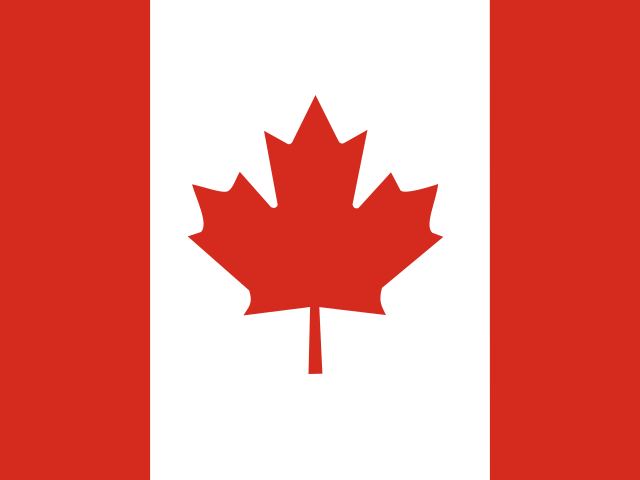
VS
Trump

Donald Trump, the President of the United States, and the people of Canada are the two sides in this dispute.
Trump is known for his aggressive trade policies and nationalist rhetoric, while Canadians are citizens of a neighboring country that has long been a close ally of the U.S.
The conflict centers on Trump's executive order to rename Lake Ontario as 'Lake America,' a move that many Canadians view as a joke and an affront to their sovereignty.
The disagreement is rooted in a broader trade war between the two nations.
Trump has imposed tariffs on Canadian goods, and Canada has responded with retaliatory tariffs.
The renaming of the lake is seen as part of this escalating tension, with Canadians expressing anger and frustration, as evidenced by public reactions and media coverage.
The trade war has also affected domestic politics in Canada, with Trump's actions polarizing the Canadian political landscape.
The stakes are high, as the U.S. and Canada have historically been close economic partners, with a free-trade agreement (USMCA) in place.
The ongoing conflict threatens to damage this relationship, and there are concerns from various sectors, including farmers, about the impact of the trade war.
The situation highlights the fragility of cross-border relations and the potential for political actions to strain long-standing alliances.
*AI-generated summary of publicly available data. This is not an official statement of any party.
*AI-generated summary of publicly available statements and reporting. This is not an official statement of this party.
Supporters of Canadians argue the renaming repeats a history of US disregard for Canadian sovereignty, citing precedents like boundary disputes where America asserted dominance over shared waters.
Supporters of Canadians view the renaming as a dismissive erasure of shared history, arguing the lake’s name honors Indigenous and colonial heritage that predates the U.S. itself.
Supporters of Canadians counter that renaming Lake Ontario erases centuries of Indigenous and Canadian identity, framing the lake as a shared treaty territory, not American cultural property.
Supporters of Canadians argue the executive order exceeds US legal authority, as renaming Lake Ontario implicates Canadian sovereign territory and bilateral treaty norms.
Supporters of Canadians argue the executive order exceeds US legal authority, as Lake Ontario's waters and bed fall under Canadian sovereignty per international boundary law.
Supporters of Canadians counter that the executive order exceeds federal naming authority, as Lake Ontario falls under joint sovereignty per the Boundary Waters Treaty, requiring bilateral consent for official designations.
Supporters of Canadians argue Trump’s renaming stunt is raw power projection, exposing Ottawa’s weakness in a relationship where Washington dictates terms and Canada can only mock to save face.
Supporters of Canadians argue the renaming is a deliberate power play, not a joke—Trump tests Canada’s reaction to gauge submission.
Supporters of Canadians counter that renaming Lake Ontario is a hollow gesture, exposing Trump’s weakness: it concedes no real leverage over trade, energy, or borders, while Ottawa’s calm, cost-free dismissal neutralizes the spectacle.
Supporters of Canadians argue the renaming disregards basic respect for a sovereign neighbor, treating shared geography as a prize rather than a partnership. They maintain that unilateral acts like this erode trust and signal contempt, not humor, for Canadian territory.
Supporters of Canadians argue that renaming a shared lake without consent is a moral breach of mutual respect, treating Canadian sovereignty as expendable for political theater.
Supporters of Canadians counter that renaming a shared natural landmark unilaterally disregards Indigenous and Canadian stewardship, framing such a gesture as a moral failure of respect, not leadership.
Supporters of Canadians argue that renaming Lake Ontario mocks the sacred order of creation, where borders and heritage reflect divine stewardship.
Supporters of Canadians argue that renaming Lake Ontario disrespects a God-given natural boundary, pointing to its enduring name as part of the Creator's order and a sacred trust of heritage.
Supporters of Canadians counter that Lake Ontario's name honors centuries of Indigenous and settler heritage, a sacred trust not subject to renaming.
*AI-generated summary of publicly available statements and reporting. This is not an official statement of this party.
Supporters of Trump argue that renaming Lake Ontario honors shared North American heritage and asserts American cultural stewardship over a boundary waterway.
Supporters of Trump argue that renaming Lake Ontario honors shared North American heritage, viewing the gesture as a symbol of unity rather than disrespect. They maintain such acts reinforce cultural ties and historical bonds, not diminish Canadian sovereignty.
Supporters of Trump counter that the renaming is a symbolic gesture of shared heritage, not a claim over Canadian land, and that cultural ties across the border outweigh fleeting political grievances.
Supporters of Trump argue the executive order is a lawful exercise of federal naming authority, pointing to precedent that the U.S. can designate geographic names within its jurisdiction, though Lake Ontario is shared territory.
Supporters of Trump argue the executive order is a lawful exercise of federal naming authority over U.S. waters, asserting that no treaty cedes sovereignty over the lake's American portion.
Supporters of Trump counter that the executive order addresses only US federal maps and internal nomenclature, which falls squarely within presidential authority under the Property Clause, and no treaty obligates the US to recognize a foreign name for a domestic waterway.
Supporters of Trump argue the Lake Ontario renaming is a blunt power play, not a joke—it signals to Canada that US leverage over trade, energy, and borders outweighs sentimental attachment to a shared waterway, and Ottawa’s outrage only confirms the move’s strategic bite.
Supporters of Trump argue the Lake America order is pure leverage, not geography; they see it as a power play to remind Canada that the US sets the terms on trade and borders, with the renaming serving as a signal that Ottawa’s complaints are irrelevant to Washington’s calculatio.
Supporters of Trump counter that the renaming is a calculated negotiating signal, not empty theater—Ottawa’s mockery masks its dependency on U.S. markets and defense, proving exactly who sets the terms.
Supporters of Trump argue that renaming Lake Ontario as Lake America asserts rightful US moral leadership over shared waters, viewing the gesture as patriotic pride, not disrespect.
Supporters of Trump argue that renaming Lake Ontario is a lawful expression of American pride, and they view Canadian objections as an overreaction to a symbolic gesture they consider a matter of national sovereignty.
Supporters of Trump counter that moral claims about sovereignty ignore the moral duty to put American interests first, framing the renaming as a blunt assertion of national pride rather than contempt.
Supporters of Trump argue that renaming Lake Ontario 'Lake America' reflects a divine mandate to honor God's creation under American stewardship, citing scripture on naming as an act of dominion.
Supporters of Trump argue that renaming Lake Ontario 'Lake America' reflects a divine mandate of stewardship over shared creation, citing scripture on dominion as evidence of rightful naming authority.
Supporters of Trump counter that divine stewardship commands humanity to subdue the earth, not idolize inherited names, and that renaming Lake Ontario reflects a rightful exercise of sovereign authority over creation.
AI-generated summary of publicly available statements and reporting. This is not an official statement of this party.
Supporters of Canadians argue the renaming repeats a history of US disregard for Canadian sovereignty, citing precedents like boundary disputes where America asserted dominance over shared waters.
Supporters of Canadians view the renaming as a dismissive erasure of shared history, arguing the lake’s name honors Indigenous and colonial heritage that predates the U.S. itself.
Supporters of Canadians counter that renaming Lake Ontario erases centuries of Indigenous and Canadian identity, framing the lake as a shared treaty territory, not American cultural property.
Supporters of Canadians argue the executive order exceeds US legal authority, as renaming Lake Ontario implicates Canadian sovereign territory and bilateral treaty norms.
Supporters of Canadians argue the executive order exceeds US legal authority, as Lake Ontario's waters and bed fall under Canadian sovereignty per international boundary law.
Supporters of Canadians counter that the executive order exceeds federal naming authority, as Lake Ontario falls under joint sovereignty per the Boundary Waters Treaty, requiring bilateral consent for official designations.
Supporters of Canadians argue Trump’s renaming stunt is raw power projection, exposing Ottawa’s weakness in a relationship where Washington dictates terms and Canada can only mock to save face.
Supporters of Canadians argue the renaming is a deliberate power play, not a joke—Trump tests Canada’s reaction to gauge submission.
Supporters of Canadians counter that renaming Lake Ontario is a hollow gesture, exposing Trump’s weakness: it concedes no real leverage over trade, energy, or borders, while Ottawa’s calm, cost-free dismissal neutralizes the spectacle.
Supporters of Canadians argue the renaming disregards basic respect for a sovereign neighbor, treating shared geography as a prize rather than a partnership. They maintain that unilateral acts like this erode trust and signal contempt, not humor, for Canadian territory.
Supporters of Canadians argue that renaming a shared lake without consent is a moral breach of mutual respect, treating Canadian sovereignty as expendable for political theater.
Supporters of Canadians counter that renaming a shared natural landmark unilaterally disregards Indigenous and Canadian stewardship, framing such a gesture as a moral failure of respect, not leadership.
Supporters of Canadians argue that renaming Lake Ontario mocks the sacred order of creation, where borders and heritage reflect divine stewardship.
Supporters of Canadians argue that renaming Lake Ontario disrespects a God-given natural boundary, pointing to its enduring name as part of the Creator's order and a sacred trust of heritage.
Supporters of Canadians counter that Lake Ontario's name honors centuries of Indigenous and settler heritage, a sacred trust not subject to renaming.
Supporters of Trump argue that renaming Lake Ontario honors shared North American heritage and asserts American cultural stewardship over a boundary waterway.
Supporters of Trump argue that renaming Lake Ontario honors shared North American heritage, viewing the gesture as a symbol of unity rather than disrespect. They maintain such acts reinforce cultural ties and historical bonds, not diminish Canadian sovereignty.
Supporters of Trump counter that the renaming is a symbolic gesture of shared heritage, not a claim over Canadian land, and that cultural ties across the border outweigh fleeting political grievances.
Supporters of Trump argue the executive order is a lawful exercise of federal naming authority, pointing to precedent that the U.S. can designate geographic names within its jurisdiction, though Lake Ontario is shared territory.
Supporters of Trump argue the executive order is a lawful exercise of federal naming authority over U.S. waters, asserting that no treaty cedes sovereignty over the lake's American portion.
Supporters of Trump counter that the executive order addresses only US federal maps and internal nomenclature, which falls squarely within presidential authority under the Property Clause, and no treaty obligates the US to recognize a foreign name for a domestic waterway.
Supporters of Trump argue the Lake Ontario renaming is a blunt power play, not a joke—it signals to Canada that US leverage over trade, energy, and borders outweighs sentimental attachment to a shared waterway, and Ottawa’s outrage only confirms the move’s strategic bite.
Supporters of Trump argue the Lake America order is pure leverage, not geography; they see it as a power play to remind Canada that the US sets the terms on trade and borders, with the renaming serving as a signal that Ottawa’s complaints are irrelevant to Washington’s calculatio.
Supporters of Trump counter that the renaming is a calculated negotiating signal, not empty theater—Ottawa’s mockery masks its dependency on U.S. markets and defense, proving exactly who sets the terms.
Supporters of Trump argue that renaming Lake Ontario as Lake America asserts rightful US moral leadership over shared waters, viewing the gesture as patriotic pride, not disrespect.
Supporters of Trump argue that renaming Lake Ontario is a lawful expression of American pride, and they view Canadian objections as an overreaction to a symbolic gesture they consider a matter of national sovereignty.
Supporters of Trump counter that moral claims about sovereignty ignore the moral duty to put American interests first, framing the renaming as a blunt assertion of national pride rather than contempt.
Supporters of Trump argue that renaming Lake Ontario 'Lake America' reflects a divine mandate to honor God's creation under American stewardship, citing scripture on naming as an act of dominion.
Supporters of Trump argue that renaming Lake Ontario 'Lake America' reflects a divine mandate of stewardship over shared creation, citing scripture on dominion as evidence of rightful naming authority.
Supporters of Trump counter that divine stewardship commands humanity to subdue the earth, not idolize inherited names, and that renaming Lake Ontario reflects a rightful exercise of sovereign authority over creation.
Canada unveils a large new sign on Lake Ontario, seen as a snub to Trump.
US President Donald Trump issued an executive order to rename Lake Ontario as 'Lake America'.
A video shows Donald Trump and Mark Carney in a heated exchange, highlighting the ongoing trade war.
U.S. Agriculture Secretary Rollins defends Trump's trade war with Canada while acknowledging concerns from farmers.
Canadians are not happy with Trump over the intensifying tariff war, with some expressing strong anti-U.S. sentiments.
Canada strikes back at the U.S. with retaliatory tariffs in response to Trump's trade war measures.
According to an analysis, Trump's actions have effectively polarized the Canadian system into a two-party system, with the Liberals absorbing the Green Party vote.
Trump signed an executive order renaming Lake Ontario to 'Lake America' amid tariff tensions with Canada.