US/Saudi coalition

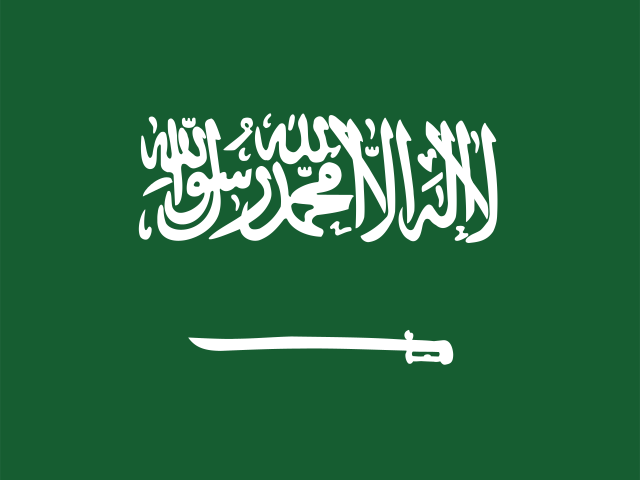
VS
Iran-aligned militias

In early August 2026, the United States and Saudi Arabia conducted coordinated airstrikes against Iran-backed militia groups in Iraq, according to U.S. military statements.
The strikes targeted weapons and other sites belonging to what the U.S. military described as 'Iran-aligned terrorists.' This joint action marked a significant escalation in the Middle East conflict, raising concerns that the fighting could spread beyond Iran.
The strikes occurred amid a broader period of heightened tensions, including Iranian attacks on a U.S. base in Jordan and Saudi efforts to build an international coalition to protect Red Sea shipping.
*AI-generated summary of publicly available data. This is not an official statement of any party.
*AI-generated summary of publicly available statements and reporting. This is not an official statement of this party.
Supporters of the US/Saudi coalition frame the strikes as defending regional order against Iranian expansion, preserving the Gulf’s traditional balance of power.
Supporters of the US/Saudi coalition argue the strikes defend regional order against Iranian expansionism, preserving the Gulf’s inherited stability and cultural continuity.
Supporters of the US/Saudi coalition counter that Iraq’s sovereignty is best served by curbing militias that undermine its national institutions, framing their strikes as preserving Iraq’s pluralistic heritage against sectarian factions imposing foreign theocratic rule.
Supporters of the US/Saudi coalition argue the strikes are lawful self-defense under Article 51, citing Iran's prior attack on a US base in Jordan as justification.
Supporters of the US/Saudi coalition argue the strikes are lawful self-defense under Article 51, citing the August 2026 attack on a US base in Jordan as evidence of ongoing armed aggression against their forces.
Supporters of the US/Saudi coalition counter that the strikes were lawful collective self-defense under Article 51, targeting imminent threats from militias operating across borders, and note that Iraq’s own government had previously requested coalition support against such.
Supporters of the US/Saudi coalition argue the strikes were a calculated deterrent: a swift, joint show of force to raise Iran's cost of proxy aggression, not an escalation but a signal that Red Sea and regional stability are non-negotiable.
Supporters of the US/Saudi coalition argue the strikes were a calculated deterrent, not aggression, targeting Iran's proxy network to expose Tehran's weakness without triggering a wider war.
Supporters of the US/Saudi coalition counter that the August 1 attack proved the militias’ asymmetry is a weakness, not leverage, since it triggered overwhelming strikes that degrade their infrastructure and force Tehran to recalculate its proxy costs.
Supporters of the US/Saudi coalition argue the strikes are a moral defense of sovereignty, targeting Iran-aligned militias to deter aggression after Iranian attacks on a US base in Jordan.
Supporters of the US/Saudi coalition argue that their strikes are a moral duty to deter terrorist aggression, viewing the targeting of militia sites as justified self-defense against Iranian provocation, including the attack on Jordan.
Supporters of the US/Saudi coalition counter that the airstrikes were a lawful act of self-defense against militias who attacked a Jordanian base, not collective punishment; sovereignty claims ignore the militias’ cross-border aggression and the coalition’s moral duty to protect.
Supporters of the US/Saudi coalition argue that their strikes uphold divine order against Iran-aligned militias, citing scripture on defending the innocent as a religious duty. They maintain that these actions preserve sacred stability in the region.
Supporters of the US/Saudi coalition argue that their strikes uphold a God-given mandate for order against militia chaos, viewing the action as righteous defense of sacred waterways and regional stability.
Supporters of the US/Saudi coalition counter that scripture equally commands obedience to lawful authority and the protection of order, which Iran-aligned militias undermine through unchecked violence and foreign interference.
*AI-generated summary of publicly available statements and reporting. This is not an official statement of this party.
Supporters of Iran-aligned militias argue that the US-Saudi strikes violate Iraqi sovereignty, framing the militias as defenders of local cultural and religious identity against foreign intervention.
Supporters of Iran-aligned militias argue that the US-Saudi strikes violate Iraqi sovereignty, framing the militias as legitimate defenders of cultural and religious identity against foreign intervention. They maintain that external powers have no right to dictate the region's.
Supporters of Iran-aligned militias counter that the strikes impose a foreign Gulf hierarchy, erasing Yemen’s and Iraq’s own tribal and religious traditions under a Saudi-led security model. They argue that cultural self-determination, not outside-imposed order, defines.
Supporters of Iran-aligned militias argue that the US-Saudi airstrikes violated Iraq's sovereignty and international law, as the strikes occurred without Baghdad's consent or a UN mandate.
Supporters of Iran-aligned militias argue that the US-Saudi airstrikes bypassed Iraq’s sovereignty and international legal procedures, as strikes lacked Baghdad’s consent or a UN Security Council mandate.
Supporters of Iran-aligned militias counter that Article 51 self-defense requires an imminent threat, not retaliation for a prior act, and the Jordan strike lacked direct militia attribution.
Supporters of Iran-aligned militias argue the strikes are a pretext to expand US-Saudi dominance, framing resistance as terrorism while ignoring that the militias’ real leverage lies in asymmetric retaliation, which the August 1 Jordan attack proved works.
Supporters of Iran-aligned militias argue the strikes are a U.S.-Saudi gambit to mask their own vulnerability, using Iraq as a proxy battlefield to bleed Iranian influence without committing ground forces, while Iran’s Jordan strike proves deterrence works only through visible.
Supporters of Iran-aligned militias counter that the strikes were a predictable miscalculation, not deterrence, as the coalition’s own incentive structure—protecting shipping lanes—now compels repeated costly patrols, while the militias’ dispersed assets and low-cost drones turn.
Supporters of Iran-aligned militias argue that the US-Saudi airstrikes, which killed at least 20, constitute collective punishment against sovereign Iraqi soil, morally illegitimate without local consent, and that the militias' defensive strikes on the Jordan base are a.
Supporters of Iran-aligned militias argue that the US-Saudi strikes violate Iraq's sovereignty, framing the militias as lawful defenders against foreign aggression, with the Jordan base attack cited as justified retaliation under self-defense.
Supporters of Iran-aligned militias counter that the strikes violate Yemeni and Iraqi sovereignty, framing the coalition’s actions as collective punishment that ignores the militias’ right to resist foreign military presence. In their view, moral defense claims ring hollow.
Supporters of Iran-aligned militias argue that their resistance is a sacred duty against foreign aggression, citing scripture that defends the oppressed against unjust invaders.
Supporters of Iran-aligned militias argue that their resistance is a divine duty against foreign aggression, citing scripture to frame the US-Saudi strikes as unjust oppression that faith compels them to withstand.
Supporters of Iran-aligned militias counter that divine order is not served by foreign bombs, citing scripture that forbids aggression and upholds the sanctity of every life, viewing the coalition’s strikes as a violation of sacred trust, not its defense.
AI-generated summary of publicly available statements and reporting. This is not an official statement of this party.
Supporters of the US/Saudi coalition frame the strikes as defending regional order against Iranian expansion, preserving the Gulf’s traditional balance of power.
Supporters of the US/Saudi coalition argue the strikes defend regional order against Iranian expansionism, preserving the Gulf’s inherited stability and cultural continuity.
Supporters of the US/Saudi coalition counter that Iraq’s sovereignty is best served by curbing militias that undermine its national institutions, framing their strikes as preserving Iraq’s pluralistic heritage against sectarian factions imposing foreign theocratic rule.
Supporters of the US/Saudi coalition argue the strikes are lawful self-defense under Article 51, citing Iran's prior attack on a US base in Jordan as justification.
Supporters of the US/Saudi coalition argue the strikes are lawful self-defense under Article 51, citing the August 2026 attack on a US base in Jordan as evidence of ongoing armed aggression against their forces.
Supporters of the US/Saudi coalition counter that the strikes were lawful collective self-defense under Article 51, targeting imminent threats from militias operating across borders, and note that Iraq’s own government had previously requested coalition support against such.
Supporters of the US/Saudi coalition argue the strikes were a calculated deterrent: a swift, joint show of force to raise Iran's cost of proxy aggression, not an escalation but a signal that Red Sea and regional stability are non-negotiable.
Supporters of the US/Saudi coalition argue the strikes were a calculated deterrent, not aggression, targeting Iran's proxy network to expose Tehran's weakness without triggering a wider war.
Supporters of the US/Saudi coalition counter that the August 1 attack proved the militias’ asymmetry is a weakness, not leverage, since it triggered overwhelming strikes that degrade their infrastructure and force Tehran to recalculate its proxy costs.
Supporters of the US/Saudi coalition argue the strikes are a moral defense of sovereignty, targeting Iran-aligned militias to deter aggression after Iranian attacks on a US base in Jordan.
Supporters of the US/Saudi coalition argue that their strikes are a moral duty to deter terrorist aggression, viewing the targeting of militia sites as justified self-defense against Iranian provocation, including the attack on Jordan.
Supporters of the US/Saudi coalition counter that the airstrikes were a lawful act of self-defense against militias who attacked a Jordanian base, not collective punishment; sovereignty claims ignore the militias’ cross-border aggression and the coalition’s moral duty to protect.
Supporters of the US/Saudi coalition argue that their strikes uphold divine order against Iran-aligned militias, citing scripture on defending the innocent as a religious duty. They maintain that these actions preserve sacred stability in the region.
Supporters of the US/Saudi coalition argue that their strikes uphold a God-given mandate for order against militia chaos, viewing the action as righteous defense of sacred waterways and regional stability.
Supporters of the US/Saudi coalition counter that scripture equally commands obedience to lawful authority and the protection of order, which Iran-aligned militias undermine through unchecked violence and foreign interference.
Supporters of Iran-aligned militias argue that the US-Saudi strikes violate Iraqi sovereignty, framing the militias as defenders of local cultural and religious identity against foreign intervention.
Supporters of Iran-aligned militias argue that the US-Saudi strikes violate Iraqi sovereignty, framing the militias as legitimate defenders of cultural and religious identity against foreign intervention. They maintain that external powers have no right to dictate the region's.
Supporters of Iran-aligned militias counter that the strikes impose a foreign Gulf hierarchy, erasing Yemen’s and Iraq’s own tribal and religious traditions under a Saudi-led security model. They argue that cultural self-determination, not outside-imposed order, defines.
Supporters of Iran-aligned militias argue that the US-Saudi airstrikes violated Iraq's sovereignty and international law, as the strikes occurred without Baghdad's consent or a UN mandate.
Supporters of Iran-aligned militias argue that the US-Saudi airstrikes bypassed Iraq’s sovereignty and international legal procedures, as strikes lacked Baghdad’s consent or a UN Security Council mandate.
Supporters of Iran-aligned militias counter that Article 51 self-defense requires an imminent threat, not retaliation for a prior act, and the Jordan strike lacked direct militia attribution.
Supporters of Iran-aligned militias argue the strikes are a pretext to expand US-Saudi dominance, framing resistance as terrorism while ignoring that the militias’ real leverage lies in asymmetric retaliation, which the August 1 Jordan attack proved works.
Supporters of Iran-aligned militias argue the strikes are a U.S.-Saudi gambit to mask their own vulnerability, using Iraq as a proxy battlefield to bleed Iranian influence without committing ground forces, while Iran’s Jordan strike proves deterrence works only through visible.
Supporters of Iran-aligned militias counter that the strikes were a predictable miscalculation, not deterrence, as the coalition’s own incentive structure—protecting shipping lanes—now compels repeated costly patrols, while the militias’ dispersed assets and low-cost drones turn.
Supporters of Iran-aligned militias argue that the US-Saudi airstrikes, which killed at least 20, constitute collective punishment against sovereign Iraqi soil, morally illegitimate without local consent, and that the militias' defensive strikes on the Jordan base are a.
Supporters of Iran-aligned militias argue that the US-Saudi strikes violate Iraq's sovereignty, framing the militias as lawful defenders against foreign aggression, with the Jordan base attack cited as justified retaliation under self-defense.
Supporters of Iran-aligned militias counter that the strikes violate Yemeni and Iraqi sovereignty, framing the coalition’s actions as collective punishment that ignores the militias’ right to resist foreign military presence. In their view, moral defense claims ring hollow.
Supporters of Iran-aligned militias argue that their resistance is a sacred duty against foreign aggression, citing scripture that defends the oppressed against unjust invaders.
Supporters of Iran-aligned militias argue that their resistance is a divine duty against foreign aggression, citing scripture to frame the US-Saudi strikes as unjust oppression that faith compels them to withstand.
Supporters of Iran-aligned militias counter that divine order is not served by foreign bombs, citing scripture that forbids aggression and upholds the sanctity of every life, viewing the coalition’s strikes as a violation of sacred trust, not its defense.
US and Saudi warplanes conducted joint strikes against alleged Iran-aligned militia sites in eastern Iraq, according to CENTCOM.
Airstrikes by US and Saudi Arabia against Iran-backed militias in Iraq, killing at least 20.
Iran launched an attack on a US base in Jordan in response to the strikes.
As the conflict with Iran escalated, Saudi Arabia reportedly sought to build an international coalition to protect Red Sea shipping, according to a video report.