Vanuatu
VS
France's far right
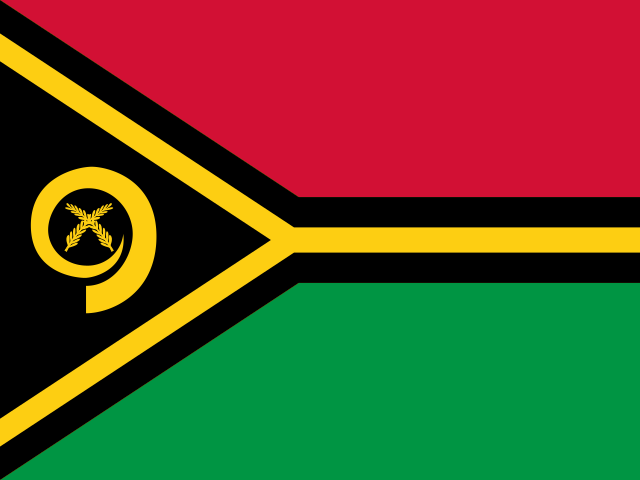
Vanuatu is a Pacific island nation that has been in a long-running dispute with France over the uninhabited Matthew and Hunter Islands, which are strategically located in the Pacific.
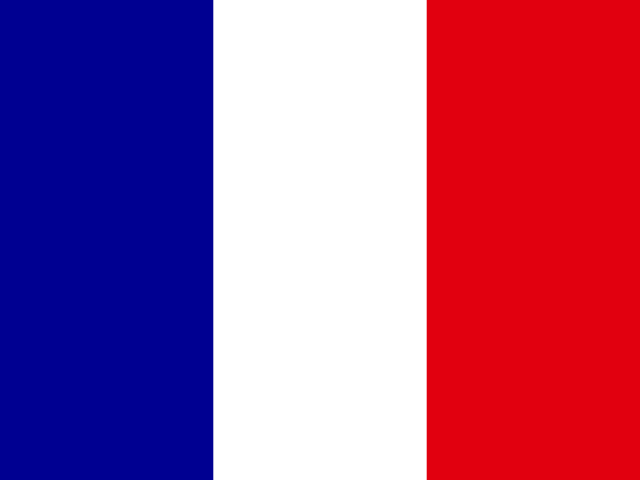
France's far-right parties, including the National Rally led by Marine Le Pen and Jordan Bardella, have been using the dispute as a political issue, opposing Vanuatu's efforts to bring the matter to international courts.
The conflict centers on sovereignty over the two islands, which Vanuatu claims as part of its territory, while France maintains control.
Vanuatu has accused France of delaying negotiations and has decided to escalate the dispute to the International Court of Justice (ICJ), urging France to accept the court's jurisdiction.
France's far-right parties have seized on the case, framing it as a matter of national pride and using it to rally support, which has further complicated the diplomatic efforts.
The stakes are high for both sides: for Vanuatu, the case represents a challenge to what it views as a colonial relic, while for France, it touches on national sovereignty and strategic interests in the Pacific.
The dispute has drawn international attention, with Vanuatu seeking to use international law to resolve a decades-old issue.
*AI-generated summary of publicly available data. This is not an official statement of any party.
*AI-generated summary of publicly available statements and reporting. This is not an official statement of this party.
Supporters of Vanuatu argue that France’s refusal to accept ICJ jurisdiction reflects a lingering colonial mindset that undermines the cultural sovereignty of Pacific islanders, whose traditions and self-governance predate French rule.
Supporters of Vanuatu argue that French control of the Pacific islands reflects a colonial tradition that disrupts the cultural continuity of indigenous communities, and they maintain that ICJ jurisdiction offers a lawful path to restore inherited sovereignty and social order.
Supporters of Vanuatu counter that French cultural heritage in the Pacific cannot erase the lived memory of colonial land seizures and systemic discrimination, arguing that historical continuity must include the voices of the colonized, not just the colonizer.
Supporters of Vanuatu argue that France’s refusal to accept International Court of Justice jurisdiction violates the legal principle that colonial-era control cannot override a people’s right to self-determination under international law.
Supporters of Vanuatu argue that France's refusal to accept ICJ jurisdiction violates the legal principle of peaceful dispute settlement, as both states are bound by the UN Charter’s commitment to judicial resolution of colonial-era claims.
Supporters of Vanuatu counter that ICJ jurisdiction concerns legal process, not territorial title, and that sovereign consent to adjudication does not legitimize or prejudice colonial-era claims.
Supporters of Vanuatu argue the ICJ push is a calculated power play, framing colonial relics as legal leverage to force France into a costly diplomatic corner, exposing its far right’s nationalist theater.
Supporters of Vanuatu argue that France's far right weaponizes colonial relics to rally nationalist votes, while Vanuatu's ICJ push is a calculated legal lever to expose power imbalances.
Supporters of Vanuatu counter that France’s sovereignty claim is itself the power play, masking strategic nuclear and military interests behind legal formality; the ICJ bid merely exposes the raw incentive structure driving colonial retention.
Supporters of Vanuatu argue that colonial-era control over Pacific islands is a moral wrong, and they maintain that submitting to the International Court of Justice is a duty to justice, not a political act.
Supporters of Vanuatu argue that France’s refusal to accept ICJ jurisdiction perpetuates a colonial relic, and they hold that moral stewardship of the Pacific demands an end to such control.
Supporters of Vanuatu counter that moral duty extends beyond national borders, as rising seas erase entire island nations, making shared history meaningless without a habitable future.
Supporters of Vanuatu argue that divine law, as reflected in scripture, condemns the dominion of one people over another, viewing French control of the Pacific islands as a moral affront to the God-given right of self-determination.
Supporters of Vanuatu argue that divine law calls for justice among nations, seeing the island dispute as a moral reckoning with colonial relics.
Supporters of Vanuatu counter that divine providence blesses the stewardship of indigenous peoples, not the dominion of distant empires, and that sacred bonds are honored through restoring ancestral lands, not preserving colonial claims.
*AI-generated summary of publicly available statements and reporting. This is not an official statement of this party.
Supporters of France's far right argue that the Pacific islands remain a living bond to French cultural heritage, not a colonial relic, and they frame Vanuatu's ICJ push as an external campaign to sever that historical continuity.
Supporters of France’s far right argue that the islands remain French through centuries of shared history and cultural heritage, calling Vanuatu’s ICJ bid a colonial-era grievance that ignores modern ties.
Supporters of France's far right counter that French sovereignty over New Caledonia is a historical fact, predating any modern ICJ rulings, and that Vanuatu’s claims ignore the cultural ties forged through generations of shared French identity.
Supporters of France's far right argue that accepting International Court of Justice jurisdiction would wrongly legitimize Vanuatu's colonial-era claims, undermining France's sovereign legal title to its Pacific territories.
Supporters of France's far right argue that accepting International Court of Justice jurisdiction would undermine French sovereignty and legal self-determination, treating the islands as subject to external adjudication rather than domestic law.
Supporters of France’s far right counter that ICJ jurisdiction is voluntary, and self-determination claims under international law do not retroactively invalidate treaties freely signed by Vanuatu’s predecessors.
Supporters of France's far right argue Vanuatu’s ICJ gambit is pure power politics, using colonial guilt to pry away sovereign territory for strategic gain.
Supporters of France's far right argue that Vanuatu's ICJ gambit is a power play disguised as decolonization, aimed at weakening French sovereignty over strategic Pacific territory.
Supporters of France’s far right counter that Vanuatu’s ICJ move is itself a cynical stunt, using postcolonial grievance to mask its own regional ambitions, while France’s nationalist rhetoric merely mirrors the same power calculus.
Supporters of France's far right argue that submitting to the International Court of Justice would morally betray French citizens overseas, whose self-determination is rooted in shared history, not colonial relics.
Supporters of France’s far right argue that moral duty lies with preserving national sovereignty and protecting French citizens in the Pacific, not with yielding to external courts.
Supporters of France's far right counter that the moral duty lies with protecting French sovereignty and its citizens' heritage, arguing that Vanuatu's claim overlooks the historical bonds and shared culture forged in the Pacific, which submission to the ICJ would undermine.
Supporters of France's far right argue that French sovereignty over these Pacific islands reflects a providential order, not a colonial relic, and that surrendering to Vanuatu's ICJ bid would unravel the sacred bonds of nation and faith.
Supporters of France's far right argue that the ICJ dispute over Pacific islands is a secular challenge to France's enduring civilizing mission, which they view as rooted in a sacred duty to preserve order and tradition.
Supporters of France's far right counter that scripture also ordains earthly authority, and French governance over Vanuatu reflects a providential mandate to preserve order and faith, not dominion.
AI-generated summary of publicly available statements and reporting. This is not an official statement of this party.
Supporters of Vanuatu argue that France’s refusal to accept ICJ jurisdiction reflects a lingering colonial mindset that undermines the cultural sovereignty of Pacific islanders, whose traditions and self-governance predate French rule.
Supporters of Vanuatu argue that French control of the Pacific islands reflects a colonial tradition that disrupts the cultural continuity of indigenous communities, and they maintain that ICJ jurisdiction offers a lawful path to restore inherited sovereignty and social order.
Supporters of Vanuatu counter that French cultural heritage in the Pacific cannot erase the lived memory of colonial land seizures and systemic discrimination, arguing that historical continuity must include the voices of the colonized, not just the colonizer.
Supporters of Vanuatu argue that France’s refusal to accept International Court of Justice jurisdiction violates the legal principle that colonial-era control cannot override a people’s right to self-determination under international law.
Supporters of Vanuatu argue that France's refusal to accept ICJ jurisdiction violates the legal principle of peaceful dispute settlement, as both states are bound by the UN Charter’s commitment to judicial resolution of colonial-era claims.
Supporters of Vanuatu counter that ICJ jurisdiction concerns legal process, not territorial title, and that sovereign consent to adjudication does not legitimize or prejudice colonial-era claims.
Supporters of Vanuatu argue the ICJ push is a calculated power play, framing colonial relics as legal leverage to force France into a costly diplomatic corner, exposing its far right’s nationalist theater.
Supporters of Vanuatu argue that France's far right weaponizes colonial relics to rally nationalist votes, while Vanuatu's ICJ push is a calculated legal lever to expose power imbalances.
Supporters of Vanuatu counter that France’s sovereignty claim is itself the power play, masking strategic nuclear and military interests behind legal formality; the ICJ bid merely exposes the raw incentive structure driving colonial retention.
Supporters of Vanuatu argue that colonial-era control over Pacific islands is a moral wrong, and they maintain that submitting to the International Court of Justice is a duty to justice, not a political act.
Supporters of Vanuatu argue that France’s refusal to accept ICJ jurisdiction perpetuates a colonial relic, and they hold that moral stewardship of the Pacific demands an end to such control.
Supporters of Vanuatu counter that moral duty extends beyond national borders, as rising seas erase entire island nations, making shared history meaningless without a habitable future.
Supporters of Vanuatu argue that divine law, as reflected in scripture, condemns the dominion of one people over another, viewing French control of the Pacific islands as a moral affront to the God-given right of self-determination.
Supporters of Vanuatu argue that divine law calls for justice among nations, seeing the island dispute as a moral reckoning with colonial relics.
Supporters of Vanuatu counter that divine providence blesses the stewardship of indigenous peoples, not the dominion of distant empires, and that sacred bonds are honored through restoring ancestral lands, not preserving colonial claims.
Supporters of France's far right argue that the Pacific islands remain a living bond to French cultural heritage, not a colonial relic, and they frame Vanuatu's ICJ push as an external campaign to sever that historical continuity.
Supporters of France’s far right argue that the islands remain French through centuries of shared history and cultural heritage, calling Vanuatu’s ICJ bid a colonial-era grievance that ignores modern ties.
Supporters of France's far right counter that French sovereignty over New Caledonia is a historical fact, predating any modern ICJ rulings, and that Vanuatu’s claims ignore the cultural ties forged through generations of shared French identity.
Supporters of France's far right argue that accepting International Court of Justice jurisdiction would wrongly legitimize Vanuatu's colonial-era claims, undermining France's sovereign legal title to its Pacific territories.
Supporters of France's far right argue that accepting International Court of Justice jurisdiction would undermine French sovereignty and legal self-determination, treating the islands as subject to external adjudication rather than domestic law.
Supporters of France’s far right counter that ICJ jurisdiction is voluntary, and self-determination claims under international law do not retroactively invalidate treaties freely signed by Vanuatu’s predecessors.
Supporters of France's far right argue Vanuatu’s ICJ gambit is pure power politics, using colonial guilt to pry away sovereign territory for strategic gain.
Supporters of France's far right argue that Vanuatu's ICJ gambit is a power play disguised as decolonization, aimed at weakening French sovereignty over strategic Pacific territory.
Supporters of France’s far right counter that Vanuatu’s ICJ move is itself a cynical stunt, using postcolonial grievance to mask its own regional ambitions, while France’s nationalist rhetoric merely mirrors the same power calculus.
Supporters of France's far right argue that submitting to the International Court of Justice would morally betray French citizens overseas, whose self-determination is rooted in shared history, not colonial relics.
Supporters of France’s far right argue that moral duty lies with preserving national sovereignty and protecting French citizens in the Pacific, not with yielding to external courts.
Supporters of France's far right counter that the moral duty lies with protecting French sovereignty and its citizens' heritage, arguing that Vanuatu's claim overlooks the historical bonds and shared culture forged in the Pacific, which submission to the ICJ would undermine.
Supporters of France's far right argue that French sovereignty over these Pacific islands reflects a providential order, not a colonial relic, and that surrendering to Vanuatu's ICJ bid would unravel the sacred bonds of nation and faith.
Supporters of France's far right argue that the ICJ dispute over Pacific islands is a secular challenge to France's enduring civilizing mission, which they view as rooted in a sacred duty to preserve order and tradition.
Supporters of France's far right counter that scripture also ordains earthly authority, and French governance over Vanuatu reflects a providential mandate to preserve order and faith, not dominion.
Vanuatu says French control of islands is relic of colonial past, as France’s far right uses case as a political weapon.
Vanuatu announced it would escalate the decades-long dispute with France over the two uninhabited islands to international arbitrators.
Foreign Affairs published an analysis of the growing odds of a Le Pen–Bardella victory in France, highlighting the far-right's political momentum.