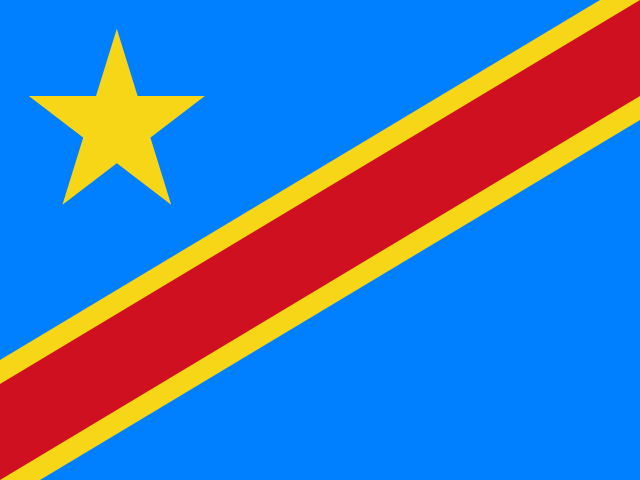
DR Congo government
VS
M23 rebels
The Democratic Republic of Congo (DRC) government is the central authority in the Democratic Republic of the Congo, a country in Central Africa.
The M23 rebels, also known as the March 23 Movement, are a rebel group largely drawn from Congolese communities of Rwandan origin, operating in the eastern part of the country.
The M23 has been active in the Kivu conflict, with a resurgence beginning in 2022, and is reportedly backed by Rwanda, although the Rwandan government has repeatedly denied providing support.
The conflict between the DRC government and the M23 rebels centers on territorial control and political influence in eastern DRC.
The rebels have been fighting the Congolese army and allied militias as they attempt to expand their territory, leading to ongoing violence and instability in the region.
The government seeks to maintain its authority and territorial integrity, while the M23 aims to assert its own control and negotiate from a position of strength.
This dispute is part of a broader regional conflict involving the DRC and Rwanda, with significant humanitarian consequences.
The fighting has led to documented abuses by both sides, including abuses by the Congolese army during the rebels' advance, as reported by Human Rights Watch.
The conflict has also drawn in international actors and peacekeeping efforts, with the ICRC facilitating humanitarian actions such as prisoner releases.
*AI-generated summary of publicly available data. This is not an official statement of any party.
*AI-generated summary of publicly available statements and reporting. This is not an official statement of this party.
Supporters of the DR Congo government argue that the prisoner release reflects a cultural tradition of reconciliation over retribution, viewing the Doha process as restoring communal bonds in North Kivu.
Supporters of DR Congo government argue the prisoner release honors a cultural tradition of reconciliation, treating M23 rebels as fellow Congolese deserving reintegration. They maintain this gesture reflects historical cycles where dialogue, not vengeance, ended past regional.
Supporters of the DR Congo government counter that M23’s prisoner release exploits ethnic identity to mask a foreign-backed insurgency, citing historical precedent where such claims preceded Rwandan expansionism, and they argue that Congolese Tutsi culture thrives under state.
Supporters of DR Congo government argue the prisoner release fulfills the Doha process's legal framework, with ICRC facilitation ensuring compliance with international humanitarian law. They maintain this transfer signals sovereign commitment to negotiated peace, not.
Supporters of DR Congo government argue the prisoner release fulfills the Doha process’s legal framework, with ICRC facilitation ensuring compliance with humanitarian law and state sovereignty.
Supporters of the DR Congo government counter that the Doha process confers no legal recognition on M23, as the government’s own constitutional and UN-facilitated frameworks, including the Luanda Roadmap, remain the sole valid basis for negotiations, and ICRC facilitation.
Supporters of DR Congo government argue the prisoner release is a calculated Doha gambit: trading 15 low-value detainees to keep M23 at the negotiating table while Kinshasa regroups militarily.
Supporters of DR Congo government argue the prisoner release is a calculated gamble: trading 15 detainees buys Doha credibility and international goodwill while testing M23’s true commitment to peace, a move that exposes rebel intentions without ceding real power.
Supporters of the DR Congo government counter that the release is a calculated move to undercut M23’s narrative, reframing it as sovereign mercy that pressures rebels into concessions, not a sign of weakness but a reassertion of control within the Doha negotiations.
Supporters of DR Congo government argue that releasing 15 prisoners to M23 rebels honors a humanitarian duty, prioritizing de-escalation and family reunification over retribution, as precedent in past peace accords shows such gestures can build trust.
Supporters of DR Congo government argue the prisoner release honors a moral duty to pursue peace over retribution, viewing the Doha process as a courageous step toward ending North Kivu’s cycle of violence.
Supporters of the DR Congo government counter that prisoner releases without a verified ceasefire embolden armed groups, as history shows concessions often precede renewed offensives. They argue that true reconciliation requires justice first, not gestures that legitimize M23’s.
Supporters of the DR Congo government argue that the prisoner release honors a sacred duty to restore order through dialogue, reflecting faith in reconciliation over vengeance.
Supporters of DR Congo government argue the prisoner release honors the sacred duty of mercy, reflecting faith that peace requires gestures of trust, even toward M23.
Supporters of the DR Congo government counter that mercy without accountability undermines justice, citing scripture’s equal mandate for order and lawful authority to restrain evil.
*AI-generated summary of publicly available statements and reporting. This is not an official statement of this party.
Supporters of M23 rebels argue that the prisoner release affirms the group's cultural legitimacy as guardians of Congolese Tutsi identity in North Kivu.
Supporters of M23 rebels view the prisoner release as recognition of their cultural and political legitimacy in North Kivu, arguing it affirms their role as guardians of Tutsi and Congolese identity against government marginalization.
Supporters of M23 rebels counter that the prisoner release ignores the cultural trauma of Tutsi communities, whose bonds were shattered by state-backed persecution, making reconciliation premature without justice.
Supporters of M23 rebels argue the prisoner release establishes a legal precedent under the Doha process, affirming their status as a recognized party to negotiations rather than mere outlaws, with ICRC facilitation legitimizing their juridical standing in North Kivu.
Supporters of M23 rebels argue the prisoner release is a lawful step under the Doha process, recognizing M23 as a legitimate party to negotiations. They maintain that ICRC facilitation upholds legal standards, and that the transfer sets a precedent for future compliance with.
Supporters of M23 rebels counter that the Doha process lacks binding legal force, as the government unilaterally selects detainees without judicial review, violating due process under Congolese law. They argue ICRC facilitation does not cure procedural defects, and the release.
Supporters of M23 rebels argue the prisoner release is not charity but a strategic concession, exposing the DR Congo government’s weakened hand in the Doha process.
Supporters of M23 rebels see the prisoner release as proof that the Doha process legitimizes their leverage, rewarding armed pressure over state authority.
Supporters of M23 rebels counter that the prisoner release is a Kinshasa admission of weakness, not strategy, as Doha’s real prize is legitimacy for the rebels’ territorial gains.
Supporters of M23 rebels argue that the prisoner release is a moral step toward reconciliation, showing both sides can honor peace over vengeance. They maintain that such gestures, under Doha and ICRC guidance, prove M23’s commitment to lawful process, not defiance.
Supporters of M23 rebels argue that the prisoner release honors the Doha peace process, showing the rebels' commitment to reconciliation over vengeance in North Kivu.
Supporters of M23 rebels counter that the release of 15 prisoners is not a humanitarian gesture but a hollow token, as the government’s own forces continue to detain civilians without trial, violating divine justice that demands equal mercy for all.
Supporters of M23 rebels view the prisoner release as a step toward restorative justice, arguing that forgiveness and reconciliation are sacred duties that echo scripture's call for mercy.
Supporters of M23 rebels see the prisoner release as a step toward justice under divine law, viewing peace as a sacred duty that transcends earthly authority.
Supporters of M23 rebels counter that releasing prisoners without addressing root injustices profanes divine justice, as scripture demands righteousness over hollow peace.
AI-generated summary of publicly available statements and reporting. This is not an official statement of this party.
Supporters of the DR Congo government argue that the prisoner release reflects a cultural tradition of reconciliation over retribution, viewing the Doha process as restoring communal bonds in North Kivu.
Supporters of DR Congo government argue the prisoner release honors a cultural tradition of reconciliation, treating M23 rebels as fellow Congolese deserving reintegration. They maintain this gesture reflects historical cycles where dialogue, not vengeance, ended past regional.
Supporters of the DR Congo government counter that M23’s prisoner release exploits ethnic identity to mask a foreign-backed insurgency, citing historical precedent where such claims preceded Rwandan expansionism, and they argue that Congolese Tutsi culture thrives under state.
Supporters of DR Congo government argue the prisoner release fulfills the Doha process's legal framework, with ICRC facilitation ensuring compliance with international humanitarian law. They maintain this transfer signals sovereign commitment to negotiated peace, not.
Supporters of DR Congo government argue the prisoner release fulfills the Doha process’s legal framework, with ICRC facilitation ensuring compliance with humanitarian law and state sovereignty.
Supporters of the DR Congo government counter that the Doha process confers no legal recognition on M23, as the government’s own constitutional and UN-facilitated frameworks, including the Luanda Roadmap, remain the sole valid basis for negotiations, and ICRC facilitation.
Supporters of DR Congo government argue the prisoner release is a calculated Doha gambit: trading 15 low-value detainees to keep M23 at the negotiating table while Kinshasa regroups militarily.
Supporters of DR Congo government argue the prisoner release is a calculated gamble: trading 15 detainees buys Doha credibility and international goodwill while testing M23’s true commitment to peace, a move that exposes rebel intentions without ceding real power.
Supporters of the DR Congo government counter that the release is a calculated move to undercut M23’s narrative, reframing it as sovereign mercy that pressures rebels into concessions, not a sign of weakness but a reassertion of control within the Doha negotiations.
Supporters of DR Congo government argue that releasing 15 prisoners to M23 rebels honors a humanitarian duty, prioritizing de-escalation and family reunification over retribution, as precedent in past peace accords shows such gestures can build trust.
Supporters of DR Congo government argue the prisoner release honors a moral duty to pursue peace over retribution, viewing the Doha process as a courageous step toward ending North Kivu’s cycle of violence.
Supporters of the DR Congo government counter that prisoner releases without a verified ceasefire embolden armed groups, as history shows concessions often precede renewed offensives. They argue that true reconciliation requires justice first, not gestures that legitimize M23’s.
Supporters of the DR Congo government argue that the prisoner release honors a sacred duty to restore order through dialogue, reflecting faith in reconciliation over vengeance.
Supporters of DR Congo government argue the prisoner release honors the sacred duty of mercy, reflecting faith that peace requires gestures of trust, even toward M23.
Supporters of the DR Congo government counter that mercy without accountability undermines justice, citing scripture’s equal mandate for order and lawful authority to restrain evil.
Supporters of M23 rebels argue that the prisoner release affirms the group's cultural legitimacy as guardians of Congolese Tutsi identity in North Kivu.
Supporters of M23 rebels view the prisoner release as recognition of their cultural and political legitimacy in North Kivu, arguing it affirms their role as guardians of Tutsi and Congolese identity against government marginalization.
Supporters of M23 rebels counter that the prisoner release ignores the cultural trauma of Tutsi communities, whose bonds were shattered by state-backed persecution, making reconciliation premature without justice.
Supporters of M23 rebels argue the prisoner release establishes a legal precedent under the Doha process, affirming their status as a recognized party to negotiations rather than mere outlaws, with ICRC facilitation legitimizing their juridical standing in North Kivu.
Supporters of M23 rebels argue the prisoner release is a lawful step under the Doha process, recognizing M23 as a legitimate party to negotiations. They maintain that ICRC facilitation upholds legal standards, and that the transfer sets a precedent for future compliance with.
Supporters of M23 rebels counter that the Doha process lacks binding legal force, as the government unilaterally selects detainees without judicial review, violating due process under Congolese law. They argue ICRC facilitation does not cure procedural defects, and the release.
Supporters of M23 rebels argue the prisoner release is not charity but a strategic concession, exposing the DR Congo government’s weakened hand in the Doha process.
Supporters of M23 rebels see the prisoner release as proof that the Doha process legitimizes their leverage, rewarding armed pressure over state authority.
Supporters of M23 rebels counter that the prisoner release is a Kinshasa admission of weakness, not strategy, as Doha’s real prize is legitimacy for the rebels’ territorial gains.
Supporters of M23 rebels argue that the prisoner release is a moral step toward reconciliation, showing both sides can honor peace over vengeance. They maintain that such gestures, under Doha and ICRC guidance, prove M23’s commitment to lawful process, not defiance.
Supporters of M23 rebels argue that the prisoner release honors the Doha peace process, showing the rebels' commitment to reconciliation over vengeance in North Kivu.
Supporters of M23 rebels counter that the release of 15 prisoners is not a humanitarian gesture but a hollow token, as the government’s own forces continue to detain civilians without trial, violating divine justice that demands equal mercy for all.
Supporters of M23 rebels view the prisoner release as a step toward restorative justice, arguing that forgiveness and reconciliation are sacred duties that echo scripture's call for mercy.
Supporters of M23 rebels see the prisoner release as a step toward justice under divine law, viewing peace as a sacred duty that transcends earthly authority.
Supporters of M23 rebels counter that releasing prisoners without addressing root injustices profanes divine justice, as scripture demands righteousness over hollow peace.
Congolese President Felix Tshisekedi has ruled out the participation of the Rwanda-backed M23 armed group in a planned national dialogue aimed at reconciliation in the conflict-hit Democratic Republic of Congo.
A ceasefire verification team arrived in South Kivu province to investigate alleged violations.
Fighting persists in the mineral-rich region despite ceasefire agreements.
Negotiators representing the Democratic Republic of Congo and Rwanda-backed M23 rebels have agreed to a roadmap for peace. The US State Department, a mediator, released a joint statement.
DR Congo and M23 rebels agreed on a roadmap for peace talks to end the conflict.
Representatives from DR Congo and M23 rebels met in Switzerland to agree on a roadmap for peace talks.
AFC/M23 rebel alliance imposes new restrictions on movement in areas under its control following detection of Ebola cases linked to travel from government-held territory.
Kinshasa hands over 15 prisoners to the rebel alliance as part of the Doha Framework process.
DR Congo released 15 prisoners to M23 rebels as part of the Doha peace process, facilitated by the ICRC.
BBC News published an article detailing the ongoing fighting between M23 and the Congolese army and allied militia, as rebels attempt to expand their territory.
As of 10 May 2025, the military situation in the M23 campaign was documented, showing the ongoing conflict dynamics.
DRC and M23 agree on a roadmap for peace talks.
The M23 campaign (2022–present) began as part of the Kivu conflict and the DRC–Rwanda conflict, marking a resurgence of the rebel group's activities.
In April 2012, former National Congress for the Defence of the People (CNDP) soldiers mutinied against the DRC government, leading to the formation of the M23 rebellion.