Chad and Venezuela
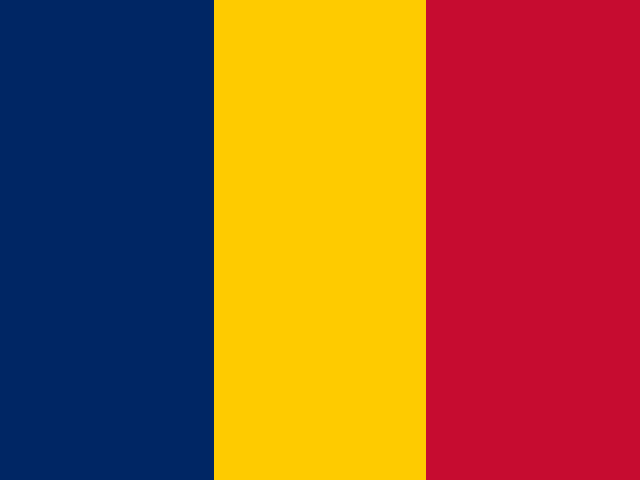
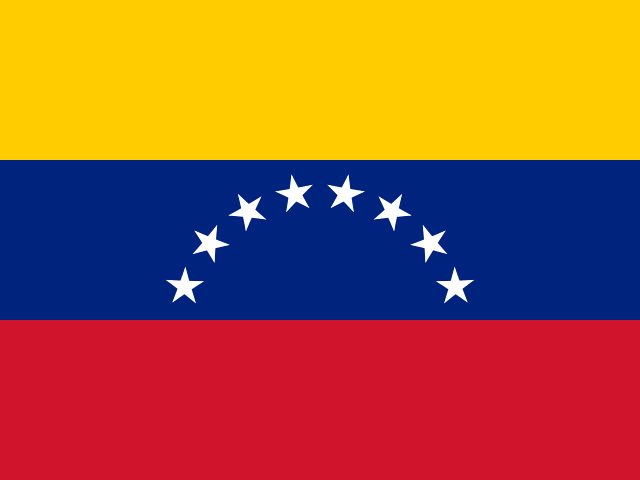
VS
ICC oversight body

The International Criminal Court (ICC) oversight body, the Assembly of States Parties, is in a dispute with Chad and Venezuela over their decisions to withdraw from the Rome Statute, the treaty that established the ICC.
The ICC is a permanent international court that prosecutes individuals for genocide, crimes against humanity, war crimes, and crimes of aggression.
Chad is a Central African nation, and Venezuela is a South American country led by President Nicolás Maduro, whose government has been under ICC investigation since 2018.
The conflict arises because Chad and Venezuela have announced their withdrawal from the Rome Statute, a move that the ICC's oversight body opposes.
Venezuela has accused the ICC of bias against countries in the Global South, while Chad has cited its own reasons for leaving.
The ICC Presidency has called on both countries to remain committed States Parties and to continue engaging constructively within the court's framework, warning that their exits threaten global justice.
The stakes are significant, as the withdrawals come amid a broader contest over the ICC's authority and legitimacy, including intensified criticism from the United States.
The ICC has been investigating Venezuela since 2018, and in 2024, its Appeals Chamber denied the Venezuelan government's appeal against a Pre-Trial Chamber decision, underscoring the ongoing legal tensions between the court and the Maduro administration.
*AI-generated summary of publicly available data. This is not an official statement of any party.
*AI-generated summary of publicly available statements and reporting. This is not an official statement of this party.
Supporters of Chad and Venezuela argue that the ICC’s oversight body, as a distant external authority, fails to respect each nation’s sovereign cultural and legal traditions, viewing its pressure as an infringement on their right to self-determination.
Supporters of Chad and Venezuela argue that the ICC's oversight body disregards each nation's sovereign cultural right to define justice through its own traditions, viewing the withdrawal as a defense of local legal identity.
Supporters of Chad and Venezuela counter that cooperative justice is a colonial relic, not a shared tradition, and that withdrawal defends each nation’s sovereign cultural autonomy against an imposed legal hierarchy.
Supporters of Chad and Venezuela argue that the Rome Statute's withdrawal is a lawful exercise of sovereign treaty rights, and that the ICC's oversight body oversteps its legal mandate by urging reversal, as no binding rule compels states to remain party to the court.
Supporters of Chad and Venezuela argue that the Rome Statute's withdrawal is a lawful exercise of sovereign treaty rights, and that the ICC's oversight body oversteps its legal mandate by demanding reversal rather than respecting each state's procedural autonomy.
Supporters of Chad and Venezuela counter that the Rome Statute’s own Article 127 permits withdrawal, and that treaty obligations cease upon exit, barring only crimes already under active ICC investigation.
Supporters of Chad and Venezuela argue the ICC's plea is pure power politics, as withdrawal shields sovereignty from Western-backed prosecutorial overreach, a pragmatic move that prioritizes national control over symbolic justice.
Supporters of Chad and Venezuela argue the ICC’s plea is a power play, not principle, as the court’s authority hinges on the weak, while the US campaign exposes its selective bite.
Supporters of Chad and Venezuela counter that the exits are a rational hedge against a court whose leverage evaporates without US backing, framing withdrawal as a sovereignty shield, not a flight from justice.
Supporters of Chad and Venezuela argue that sovereignty and self-determination are moral duties, and that withdrawing from the ICC reflects a just rejection of external judicial overreach they see as undermining national dignity.
Supporters of Chad and Venezuela argue that withdrawing from the Rome Statute upholds their sovereign duty to protect national dignity, viewing the ICC’s pressure as a moral overreach that ignores each nation’s right to interpret justice through its own laws and traditions.
Supporters of Chad and Venezuela counter that sovereignty is a divine trust, and no treaty can override a nation’s sacred duty to protect its own people from external judgment. They argue that moral accountability flows from God’s law, not a Rome-based court, and that withdrawal.
Supporters of Chad and Venezuela argue that national sovereignty is a sacred trust, and withdrawing from the Rome Statute preserves their God-given duty to uphold local laws and customs over external court rulings.
Supporters of Chad and Venezuela argue that sovereignty is a sacred duty before God, and no external tribunal may override a nation's moral covenant with its people.
Supporters of Chad and Venezuela counter that sovereignty is a divine trust, and no treaty can supersede the sacred duty of a nation to guard its own people, as scripture grants rulers authority from God alone.
*AI-generated summary of publicly available statements and reporting. This is not an official statement of this party.
Supporters of the ICC oversight body argue that Chad's and Venezuela's withdrawals reject the inherited legal order that binds nations to shared accountability, seeing such exits as a break with the cultural tradition of cooperative justice.
Supporters of the ICC oversight body argue that its appeal to Chad and Venezuela upholds the shared legal heritage and institutional continuity that bind nations to the Rome Statute, viewing withdrawal as a rupture of longstanding international order.
Supporters of the ICC oversight body counter that cultural tradition does not shield grave human rights abuses, as international norms like the Rome Statute reflect shared, evolving global values that nations voluntarily adopt.
Supporters of the ICC oversight body argue that Chad and Venezuela’s withdrawals violate their binding legal obligations under the Rome Statute, as withdrawal does not erase accountability for crimes committed during membership.
Supporters of the ICC oversight body argue that Chad and Venezuela’s withdrawals violate their binding legal commitments under the Rome Statute, as treaty obligations cannot be unilaterally discarded without due process.
Supporters of the ICC oversight body counter that the Rome Statute’s withdrawal clauses do not negate treaty obligations accrued during membership, and that urging reversal falls within the Court’s legal mandate to ensure accountability for ongoing crimes.
Supporters of ICC oversight body see the exits as a calculated power play by states fleeing accountability, warning that Chad and Venezuela’s withdrawals weaken the court’s leverage just as the US campaign to delegitimize it gains ground.
Supporters of the ICC oversight body argue that Chad and Venezuela's exits are a calculated power play, not principle, warning that weak states abandon the court only when accountability threatens their grip.
Supporters of the ICC oversight body counter that withdrawal signals guilt, not sovereignty, and that Chad and Venezuela’s exit invites rival powers to fill the vacuum with impunity, trading symbolic control for real diplomatic isolation.
Supporters of the ICC oversight body argue that Chad and Venezuela’s withdrawals breach a moral duty to uphold shared accountability for atrocity crimes, treating the Rome Statute as a binding covenant rather than a disposable tool. They maintain that exiting undermines the.
Supporters of the ICC oversight body argue that Chad and Venezuela's withdrawals abandon a shared moral duty to protect the vulnerable. They maintain that shielding perpetrators from accountability weakens the global commitment to stewardship of justice, leaving victims without.
Supporters of the ICC oversight body counter that sovereignty carries a moral duty to protect vulnerable populations, and that withdrawing from the Court abandons that obligation, shielding grave crimes from accountability.
Supporters of the ICC oversight body argue that withdrawing from the Rome Statute, as Chad and Venezuela have done, breaks a sacred covenant of global accountability, echoing scripture's call for justice to roll down like waters.
Supporters of the ICC oversight body argue that scripture calls for impartial judgment, so nations like Chad and Venezuela abandoning the Rome Statute defies a divine mandate for universal accountability.
Supporters of the ICC oversight body argue that divine justice transcends national borders, citing scripture’s call to protect the vulnerable, and that no sovereign law may shield atrocities from universal moral accountability.
AI-generated summary of publicly available statements and reporting. This is not an official statement of this party.
Supporters of Chad and Venezuela argue that the ICC’s oversight body, as a distant external authority, fails to respect each nation’s sovereign cultural and legal traditions, viewing its pressure as an infringement on their right to self-determination.
Supporters of Chad and Venezuela argue that the ICC's oversight body disregards each nation's sovereign cultural right to define justice through its own traditions, viewing the withdrawal as a defense of local legal identity.
Supporters of Chad and Venezuela counter that cooperative justice is a colonial relic, not a shared tradition, and that withdrawal defends each nation’s sovereign cultural autonomy against an imposed legal hierarchy.
Supporters of Chad and Venezuela argue that the Rome Statute's withdrawal is a lawful exercise of sovereign treaty rights, and that the ICC's oversight body oversteps its legal mandate by urging reversal, as no binding rule compels states to remain party to the court.
Supporters of Chad and Venezuela argue that the Rome Statute's withdrawal is a lawful exercise of sovereign treaty rights, and that the ICC's oversight body oversteps its legal mandate by demanding reversal rather than respecting each state's procedural autonomy.
Supporters of Chad and Venezuela counter that the Rome Statute’s own Article 127 permits withdrawal, and that treaty obligations cease upon exit, barring only crimes already under active ICC investigation.
Supporters of Chad and Venezuela argue the ICC's plea is pure power politics, as withdrawal shields sovereignty from Western-backed prosecutorial overreach, a pragmatic move that prioritizes national control over symbolic justice.
Supporters of Chad and Venezuela argue the ICC’s plea is a power play, not principle, as the court’s authority hinges on the weak, while the US campaign exposes its selective bite.
Supporters of Chad and Venezuela counter that the exits are a rational hedge against a court whose leverage evaporates without US backing, framing withdrawal as a sovereignty shield, not a flight from justice.
Supporters of Chad and Venezuela argue that sovereignty and self-determination are moral duties, and that withdrawing from the ICC reflects a just rejection of external judicial overreach they see as undermining national dignity.
Supporters of Chad and Venezuela argue that withdrawing from the Rome Statute upholds their sovereign duty to protect national dignity, viewing the ICC’s pressure as a moral overreach that ignores each nation’s right to interpret justice through its own laws and traditions.
Supporters of Chad and Venezuela counter that sovereignty is a divine trust, and no treaty can override a nation’s sacred duty to protect its own people from external judgment. They argue that moral accountability flows from God’s law, not a Rome-based court, and that withdrawal.
Supporters of Chad and Venezuela argue that national sovereignty is a sacred trust, and withdrawing from the Rome Statute preserves their God-given duty to uphold local laws and customs over external court rulings.
Supporters of Chad and Venezuela argue that sovereignty is a sacred duty before God, and no external tribunal may override a nation's moral covenant with its people.
Supporters of Chad and Venezuela counter that sovereignty is a divine trust, and no treaty can supersede the sacred duty of a nation to guard its own people, as scripture grants rulers authority from God alone.
Supporters of the ICC oversight body argue that Chad's and Venezuela's withdrawals reject the inherited legal order that binds nations to shared accountability, seeing such exits as a break with the cultural tradition of cooperative justice.
Supporters of the ICC oversight body argue that its appeal to Chad and Venezuela upholds the shared legal heritage and institutional continuity that bind nations to the Rome Statute, viewing withdrawal as a rupture of longstanding international order.
Supporters of the ICC oversight body counter that cultural tradition does not shield grave human rights abuses, as international norms like the Rome Statute reflect shared, evolving global values that nations voluntarily adopt.
Supporters of the ICC oversight body argue that Chad and Venezuela’s withdrawals violate their binding legal obligations under the Rome Statute, as withdrawal does not erase accountability for crimes committed during membership.
Supporters of the ICC oversight body argue that Chad and Venezuela’s withdrawals violate their binding legal commitments under the Rome Statute, as treaty obligations cannot be unilaterally discarded without due process.
Supporters of the ICC oversight body counter that the Rome Statute’s withdrawal clauses do not negate treaty obligations accrued during membership, and that urging reversal falls within the Court’s legal mandate to ensure accountability for ongoing crimes.
Supporters of ICC oversight body see the exits as a calculated power play by states fleeing accountability, warning that Chad and Venezuela’s withdrawals weaken the court’s leverage just as the US campaign to delegitimize it gains ground.
Supporters of the ICC oversight body argue that Chad and Venezuela's exits are a calculated power play, not principle, warning that weak states abandon the court only when accountability threatens their grip.
Supporters of the ICC oversight body counter that withdrawal signals guilt, not sovereignty, and that Chad and Venezuela’s exit invites rival powers to fill the vacuum with impunity, trading symbolic control for real diplomatic isolation.
Supporters of the ICC oversight body argue that Chad and Venezuela’s withdrawals breach a moral duty to uphold shared accountability for atrocity crimes, treating the Rome Statute as a binding covenant rather than a disposable tool. They maintain that exiting undermines the.
Supporters of the ICC oversight body argue that Chad and Venezuela's withdrawals abandon a shared moral duty to protect the vulnerable. They maintain that shielding perpetrators from accountability weakens the global commitment to stewardship of justice, leaving victims without.
Supporters of the ICC oversight body counter that sovereignty carries a moral duty to protect vulnerable populations, and that withdrawing from the Court abandons that obligation, shielding grave crimes from accountability.
Supporters of the ICC oversight body argue that withdrawing from the Rome Statute, as Chad and Venezuela have done, breaks a sacred covenant of global accountability, echoing scripture's call for justice to roll down like waters.
Supporters of the ICC oversight body argue that scripture calls for impartial judgment, so nations like Chad and Venezuela abandoning the Rome Statute defies a divine mandate for universal accountability.
Supporters of the ICC oversight body argue that divine justice transcends national borders, citing scripture’s call to protect the vulnerable, and that no sovereign law may shield atrocities from universal moral accountability.
The ICC's oversight body publicly urged Chad and Venezuela to reverse their decisions to withdraw from the Rome Statute, warning of threats to global justice.
Venezuela announced its decision to leave the ICC, accusing the court of bias against countries in the Global South. The US State Department issued a statement on the same day, criticizing the ICC's investigation of Nicolás Maduro since 2018 as having no result.
The ICC Appeals Chamber denied the Venezuelan government's appeal against a Pre-Trial Chamber decision, a step in the fight against impunity in Venezuela.